
If you are asking is LALAL.AI legal, the practical answer is: the tool itself is not automatically illegal, but your use of it can create copyright risk. In 2026, the key issue is usually not the AI stem separator. It is the audio you upload, the rights you have, and what you do with the separated vocals, instrumentals, or other stems afterward.
This article is informational only and is not legal advice. Music copyright depends on facts, licenses, contracts, and jurisdiction, so serious commercial or disputed uses should be reviewed by a qualified attorney.
Official website · Latest pricing & offers
Quick Answer: Is LALAL.AI Legal in 2026?
Short Verdict: Is LALAL.AI Legal?
In most ordinary cases, is LALAL.AI legal is better framed as: “Is my use of LALAL.AI legal?” LALAL.AI is an AI vocal remover and instrumental isolator powered by AI and transformer technology. Like many AI music tools, it can be used for lawful purposes or risky ones.
Using it on your own recordings, licensed audio, client-approved files, or public-domain material is generally the cleaner path. Using it to extract vocals from a commercial song and release a remix without permission is where copyright infringement concerns can arise.
The important distinction is this: software legality and content legality are different questions.
What Is Legal vs. What Can Be Risky
A tool that separates stems does not automatically grant you copyright rights. If you upload a copyrighted track, make a copy, generate isolated vocals, and distribute those vocals or a remix, multiple legal rights may be involved.
Here is the plain-English distinction:
| Question | Why It Matters |
|---|---|
| Is the tool lawful to access? | Usually this depends on the platform’s legal operation and terms. |
| Do you own or control the source audio? | This affects whether uploading and processing is permitted. |
| Can you use the separated output? | This depends on copyright, license scope, fair use, and contracts. |
| Can you monetize the result? | Commercial use usually requires stronger rights clearance. |
So, is LALAL.AI legal? The cautious answer is yes as a tool, but not every use of it is legally safe.
How LALAL.AI Works and Why Legal Questions Come Up
Stem Separation In Plain English
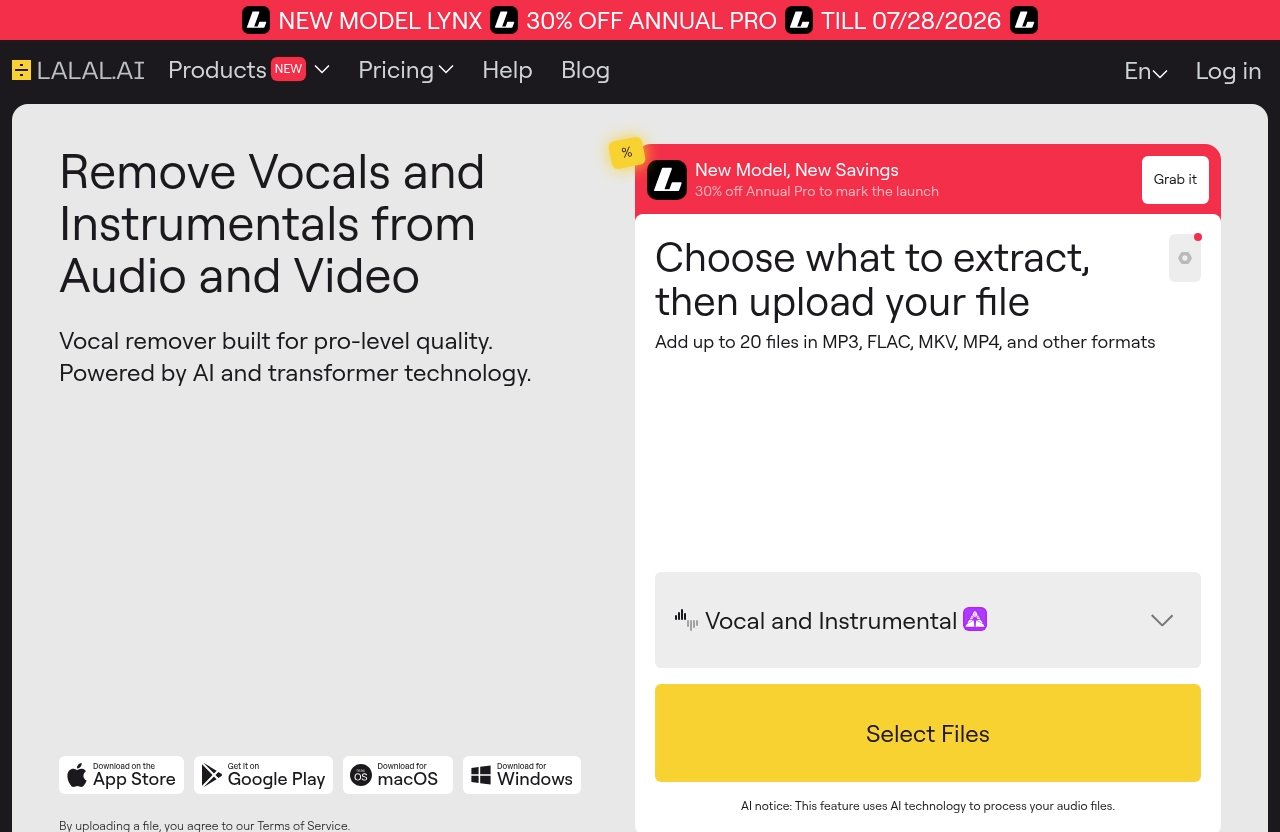
LALAL.AI uses AI to separate elements inside audio or video. Its official homepage describes it as an AI vocal remover and instrumental isolator. Its listed tools include Vocal Remover, Stem Splitter, Voice Cleaner, Voice Changer, Voice Cloner, Echo & Reverb Remover, and Lead/Back Splitter.
For music producers, the most relevant feature is stem separation. The Stem Splitter can extract vocals, instrumental, drums, bass, guitar, synth, string, and wind instruments. Apps are available for Desktop on Windows, macOS, and Linux, plus iOS and Android. LALAL.AI also lists a VST plugin that runs locally inside a DAW and an API for developers.
That technical capability is why people ask is LALAL.AI legal. The software can produce useful outputs, but useful does not always mean licensed.
Why Copyright Owners Care About Source Material
Copyright owners care because stem separation often begins with copying or processing a protected sound recording. In music, there may be rights in the recording, the composition, lyrics, performance, samples, and sometimes the video.
If you isolate a lead vocal from a famous song, you may now have a file that closely reproduces a protected performance and recording. If you then upload that stem to social platforms, sell a remix, or use it in an ad, you may be exploiting copyrighted material.
This is why ai stem separator legality is not just about the AI model. It is about music copyright and AI, permissions, licenses, and downstream distribution.
The Copyright Basics That Matter Most
What Copyright Protects In Music
Music copyright can be layered. A single released song may include at least two major rights categories:
| Copyright Layer | Common Owner Or Controller | Example |
|---|---|---|
| Musical composition | Songwriter, publisher | Melody, lyrics, chord progression as protected expression |
| Sound recording | Label, artist, producer | The specific recorded performance |
There may also be contracts covering session musicians, featured artists, samples, beats, and production elements. If you separate stems from a commercial track, you may be interacting with more than one owner’s rights.
This matters for lalal.ai copyright questions because getting permission from one party may not be enough. For example, permission from a vocalist may not clear the sound recording, and permission from a producer may not clear the publishing.
Derivative Works, Reproduction, And Public Distribution
Copyright law often gives owners control over reproductions, derivative works, distribution, public performance, and other uses. A separated stem can raise questions about reproduction because it may contain a copied portion of the original recording.
A remix, mashup, sample-based beat, or reworked instrumental can also raise derivative work issues. Even if you transform the sound creatively, you may still need permission if your final work contains recognizable copyrighted material.
This is why the answer to is separating stems illegal is not a simple yes or no. Separating your own stems is usually very different from separating and monetizing someone else’s recording.
Why Uploading A Song Is A Separate Issue
Many users focus only on the output: “Can I release this acapella remix?” But uploading can matter too.
When you upload a file to any online service, you may be making a copy or transmitting content. Whether that is allowed depends on your rights, the platform’s terms, any license you have, and applicable law.
That does not mean every private upload is automatically infringement in every jurisdiction. It means is LALAL.AI legal depends partly on what rights you have before the processing even begins.
Is Stem Separation Legal for Personal Use?
Private Study, Practice, And Archiving
For producers and musicians, stem separation can be useful for ear training, arrangement study, transcription, mixing practice, or learning how records are built. Private, non-commercial, non-distributed use is often lower risk than publishing or monetizing the result.
For example, separating drums from a track to study groove placement is different from selling those drums as a sample pack. Practicing a cover at home with an instrumental is different from uploading a monetized karaoke video.
Still, “personal use” is not a magic legal shield. If you are asking is LALAL.AI legal for private study, the risk may be lower, but the answer still depends on copyright law and license terms.
Home Remixing And Personal Projects
Home remixing is common. Many producers experiment with acapellas, instrumentals, and reference tracks privately before deciding whether to pursue clearance.
That type of private experimentation can be a practical part of production. But the moment you share the remix publicly, send it to a label, upload it to streaming services, or use it in paid content, the legal analysis changes.
A good working rule: experiment privately if you understand the risk, but do not assume you can distribute or monetize anything just because an AI tool created the stem.
When Personal Use Can Still Be Risky
Personal use can become risky when files are shared, synced to video, posted in social clips, stored in shared client folders, or used in a public portfolio. Even “unlisted” or “private link” distribution may count as sharing under some platform rules or contracts.
Risk can also increase if your source file came from a streaming service, subscription library, or download platform whose terms prohibit copying, extraction, remixing, or machine processing.
That is why the question is stem separation legal often requires checking both copyright law and the license for the specific audio source.
Is Stem Separation Legal for Commercial Use?
Client Work And Paid Production
Commercial use is where caution matters most. If a client sends you audio they own or have licensed, stem separation may be a normal production workflow. But you should confirm that the client actually has the rights they claim.
For paid production, ask practical questions:
| Question | Why It Helps |
|---|---|
| Who owns the recording? | Confirms authority to process it. |
| Who owns the composition? | Helps avoid publishing issues. |
| Is there written permission? | Creates a record if questions arise. |
| Can AI processing be used? | Some contracts may restrict AI tools. |
| Can outputs be commercially released? | Prevents scope-of-license problems. |
If someone asks can I use LALAL.AI commercially, the safest answer is: only when you have the necessary rights for the source audio and the final use.
Content Creators And YouTubers
Content creators often want to remove vocals, create background versions, isolate dialogue, or make edits for videos. This can be useful, but platform rules and copyright law are separate.
A platform may allow upload, flag it, mute it, demonetize it, or remove it. That platform outcome does not necessarily decide whether the use is lawful. It also does not guarantee you are safe from claims by rights holders.
For creators, lalal.ai commercial use is most sensitive when videos are monetized, sponsored, used for brand promotion, or republished across multiple channels. If the underlying song is copyrighted and not licensed for that purpose, stem separation does not cure the problem.
Commercial Releases, Ads, And Sync Uses
Commercial releases, advertisements, games, films, podcasts, and branded content usually require clear rights. If your final work includes a separated vocal, instrumental phrase, drum groove, or other recognizable protected material from someone else’s track, clearance may be needed.
This is especially true for sync uses, where music is paired with visual media. Labels, publishers, artists, and sample owners may all be involved.
Brief risk disclaimer: commercial music use can create financial, contractual, and reputational exposure. If a release, campaign, or client project depends on separated copyrighted audio, get legal advice before launch.
Official website · Latest pricing & offers
Fair Use, Fair Dealing, and Other Exceptions
What Fair Use Might Cover
In the United States, fair use can sometimes apply to criticism, commentary, teaching, research, parody, news reporting, and transformative uses. A producer analyzing a short excerpt for education may have a different risk profile than a brand using an isolated vocal in an advertisement.
The phrase lalal.ai fair use comes up often, but fair use is not automatic. It is a legal defense evaluated through factors such as purpose, nature of the work, amount used, and market effect.
A use can be creative, educational, or non-commercial and still not clearly qualify. Fair use is fact-specific.
Why Fair Use Is Fact-Specific
Fair use is not a permission slip you apply to a file before uploading it. It is usually assessed after looking at the entire context.
Important questions include:
- Are you commenting on or transforming the original work?
- How much of the original did you use?
- Is the original highly creative?
- Could your use substitute for the original market?
- Are you monetizing the result?
- Is the separated stem recognizable?
If your use is disputed, a court or legal process may ultimately decide. That uncertainty is why is LALAL.AI legal should not be answered with “fair use covers it” unless the facts are carefully reviewed.
Why Outside The U.S. Rules Differ
Many readers are outside the U.S., where “fair dealing” or other exceptions may apply instead of fair use. These rules can be narrower and more specific.
For example, some jurisdictions have exceptions for research, private study, criticism, review, parody, quotation, or education, but the details vary. Moral rights may also matter in some countries, especially where attribution and integrity rights are strong.
Because laws differ, lalal.ai legal status is best understood as jurisdiction-dependent. Local legal advice is especially important for commercial releases or cross-border distribution.
What LALAL.AI’s Terms Say and Why That Matters
Terms Of Service And Copyright Disclaimer
The official LALAL.AI Terms of Service and EULA matter because they govern how users may access and use the software. Terms commonly address user obligations, permitted and prohibited uses, account rules, intellectual property, and responsibility for uploaded content.
When reviewing lalal.ai terms of service, look for provisions about copyright, user-uploaded files, licenses you grant to the platform, prohibited infringement, and responsibility for ensuring you have rights. Do not rely on assumptions.
This article does not quote the terms because users should read the current official documents directly. Terms can change, and the version that applies may depend on when and how you use the service.
DMCA Compliance And User Responsibility
Services that handle user-uploaded content often include copyright complaint or DMCA-related processes, especially for U.S.-connected operations. That type of compliance process does not mean users are allowed to upload anything.
The practical point is simple: the platform may provide the tool, but you are typically responsible for the content you upload and how you use the output.
If you process copyrighted material without rights, a copyright owner may still object even if the software successfully separated the stems.
How Platform Terms Interact With Copyright Law
Platform terms do not override copyright law. A service’s terms may give you permission to use the software, but they do not grant rights in a third-party song unless clearly stated by the rights holder.
Likewise, copyright law does not automatically let you ignore platform rules. You may have a legal exception for one purpose but still violate a service contract, client agreement, or music library license.
So, when asking is LALAL.AI legal, check both layers: the law and the terms that apply to your audio source, your client, and the tool.
Safe-Use Checklist Before You Upload Anything
Use Audio You Own Or Are Licensed To Use
The safest workflow is to use audio you created, recorded, or licensed. Original vocals, your own instrument recordings, self-produced beats, and properly cleared client files are generally cleaner than commercial songs pulled from streaming platforms.
Before uploading, ask:
- Did I create this recording?
- Do I own the master?
- Do I control the composition?
- Did all collaborators agree?
- Does my license allow editing, extraction, AI processing, and commercial use?
This checklist helps turn is LALAL.AI legal from a vague concern into a practical rights review.
Check Platform/Client Permissions
If the audio comes from a client, sample library, production music catalog, stock site, label, or collaborator, check the contract. Some licenses allow editing but not redistribution of isolated parts. Others allow commercial use but prohibit resale as samples.
For client work, get written approval before using AI stem separation, especially if the project is confidential, unreleased, or tied to a major campaign.
A simple email confirming permission is better than a verbal assumption.
Keep Records Of Licenses And Releases
Keep a folder with licenses, split sheets, work-for-hire agreements, client approvals, and release forms. If a platform, distributor, label, or advertiser asks questions later, documentation can save time and reduce confusion.
Good records are especially important for commercial releases. They show where the audio came from and what you were allowed to do with it.
This does not guarantee legal safety, but it strengthens your position and helps professionals evaluate your rights.
Avoid Distributing Infringing Stems
Do not upload isolated vocals, instrumentals, drums, or other stems from copyrighted songs as downloadable files unless you have permission or a strong legal basis. Selling or giving away infringing stems can be riskier than private analysis.
Avoid using separated stems in:
- Sample packs
- Type beats
- Commercial remixes
- Ads and brand content
- Monetized videos
- Sync placements
- Public music libraries
If the stem is recognizable and came from someone else’s protected recording, assume clearance may be needed.
Common Myths About AI Stem Separators and Legality
“AI Makes It Legal”
AI does not erase copyright. If a protected song goes into an AI stem separator and a recognizable protected element comes out, the legal rights may still matter.
The fact that an algorithm separated the audio does not automatically make the output new, royalty-free, or cleared. AI processing is a method, not a license.
That is the core answer behind is LALAL.AI legal for producers: the tool can be legitimate, but the source and use decide the risk.
“Credit Solves Copyright”
Crediting the original artist is respectful, but it is not the same as permission. Attribution may be required under some licenses, but it usually does not replace clearance for copyrighted music.
If you use a separated vocal in a commercial song, adding “vocals by original artist” in the description does not necessarily make it lawful. In some cases, it may even make the use easier to identify.
Credit is good practice when required or appropriate, but licensing is the bigger issue.
“If It’s For Learning, It’s Always Fine”
Learning is a lower-risk context in many situations, but it is not automatically exempt. Private study, classroom use, online tutorials, and monetized education can be treated differently.
For example, privately isolating a bass line to practice may be much lower risk than selling a course with separated stems from famous songs. The purpose, amount used, distribution, and market effect all matter.
So, if someone asks is stem separation legal for learning, the careful answer is: often lower risk, but not automatically free from copyright concerns.
Bottom Line: When LALAL.AI Is Usually Fine and When to Get Advice
Low-Risk Scenarios
LALAL.AI is usually a lower-risk tool when you use it with audio you own, control, or are clearly licensed to process. That includes original recordings, your own demos, client files with permission, and properly licensed production material.
It can also be useful for cleanup and production workflows, such as separating elements in your own tracks or preparing materials you are authorized to edit. The official feature set includes tools for vocal removal, stem splitting, voice cleaning, echo and reverb removal, and related audio processing.
If you want to explore the tool for lawful projects, you can visit LALAL.AI through this affiliate link. Just remember that using the tool does not automatically clear third-party copyrights.
Higher-Risk Scenarios
Higher-risk scenarios usually involve copyrighted source material, public distribution, monetization, advertising, sync, sample packs, or client deliverables. If you do not own or license the original audio, commercial use becomes much more sensitive.
Be especially careful with:
- Released commercial songs
- Major-label recordings
- Famous vocals or hooks
- Unlicensed remixes
- Monetized YouTube or social content
- Brand campaigns
- Distributor-ready releases
- Stems offered for download
If the question is can I use LALAL.AI commercially, the answer depends on whether you have the necessary rights for the source audio and the final output.
When To Consult An Attorney
Consult an attorney when money, distribution, brand exposure, or disputed rights are involved. You should also get advice if you are relying on fair use, fair dealing, parody, educational exceptions, or unclear licenses.
Legal counsel is especially useful before releasing music commercially, pitching sync placements, using separated audio in ads, or building a business workflow around third-party material.
The conclusion is practical: is LALAL.AI legal in 2026? Usually, the software is not the problem. The real question is whether your source audio, license, jurisdiction, and downstream use make your project legally defensible.
Official website · Latest pricing & offers
FAQ
Is LALAL.AI Itself Illegal?
No, LALAL.AI itself is not inherently illegal. The legal risk usually depends on the audio you upload, whether you have rights to process it, and how you use the separated output.
Can I Use LALAL.AI On Copyrighted Songs?
You may be able to use it for private analysis or experimentation with lower practical risk, but uploading copyrighted songs can still raise copyright and license issues. Distribution, monetization, or public sharing is much riskier without permission.
Is Stem Separation Fair Use?
Not automatically. Fair use is fact-specific and depends on factors such as purpose, amount used, transformation, and market effect. Outside the U.S., fair dealing and other exceptions may apply differently.
Can I Sell Tracks Made With LALAL.AI?
Only if you have the necessary rights or licenses for the underlying audio and any copyrighted material in the final track. If the track contains separated parts from someone else’s recording, you may need clearance.
Does Crediting The Original Artist Make It Legal?
No. Credit does not replace permission, licensing, or a valid legal exception. Attribution may be respectful or required by a license, but it usually does not solve copyright infringement by itself.