
Separating lead and harmony parts from one finished song is one of the more difficult jobs in AI audio processing. A clean lalal.ai backing vocals result can be useful for remixing, vocal practice, arrangement study, editing, and reference work—but only if the stem is musical enough to use.
This practical review looks beyond generic AI-splitting claims. The real question is whether LALAL.AI can distinguish a lead singer from doubles, harmonies, ad-libs, and choir-style stacks without leaving distracting bleed or digital artifacts. For straightforward productions, the answer can be encouraging. For dense layered arrangements, expectations should be more conservative.
The official LALAL.AI site presents the service as an AI vocal remover and instrumental isolator. Its dedicated Lead/Back Splitter is designed to separate lead and backing vocals with “pinpoint accuracy.” That is a product claim, not a guarantee for every mix, so the source material remains the deciding factor.
Official website · Latest pricing & offers
What LALAL.AI Backing Vocals Is and Who It’s For
LALAL.AI offers a family of audio tools that includes Vocal Remover, Stem Splitter, Voice Cleaner, Voice Changer, Voice Cloner, Echo & Reverb Remover, and Lead/Back Splitter. In this lalal.ai backing vocals review, the relevant feature is the Lead/Back Splitter rather than general vocal-versus-instrumental extraction.
The goal is to take a mixed audio or video file and separate the main vocal performance from supporting vocal material. That makes it potentially valuable when a normal acapella stem is not enough and you specifically need to inspect or use the harmonies.
Definition of lead vs. backing vocals
Lead vocals carry the primary lyric, melody, or narrative focus. They are usually centered in the mix, more prominent than other voices, and treated as the main performance.
Backing vocals can include:
- Harmonies above or below the lead melody
- Doubled phrases and chorus reinforcement
- Call-and-response lines
- Group vocals and crowd-style layers
- Ad-libs placed around the primary vocal
- Choir stacks, pads, and sustained vowel parts
In a simple recording, the difference is obvious to both a listener and an AI system. In a modern pop, R&B, gospel, or cinematic arrangement, the distinction becomes much less clear. If the lead is doubled tightly or harmonies sing the same lyric at the same time, a lalal.ai backing vocals split has to make judgment calls that may not match the producer’s original session organization.
Best use cases: remixes, practice tracks, reference extraction, vocal editing
The strongest reason to use a lead-versus-backing tool is not necessarily to create a release-ready multitrack. It is often to create a usable working reference faster than rebuilding an arrangement by ear.
Good practical uses include:
- Extracting harmony ideas for a remix or cover arrangement
- Making vocal-practice material where the main line and support parts need separate attention
- Studying how choruses expand from verse to hook
- Identifying where doubles enter and leave
- Preparing rough edit guides before a more detailed manual cleanup
- Creating reference material for singers, educators, and arrangers
For broader context, our guide to [acapella and instrumental splits](/acapella-vs-instrumental-splits/) explains why isolating “vocals” is generally easier than separating individual vocal roles inside one acapella.
Who should care: producers, singers, editors, podcasters, educators
Producers and remixers may find the lalal.ai lead and back vocal splitter useful for quickly exploring an arrangement. Singers can use it to hear harmony movement that is masked by the lead. Editors may use it as a starting point when they need to reduce a distracting vocal layer rather than eliminate all singing.
Podcasters and spoken-word editors are a less obvious audience, but the tool may help when a clip contains a foreground speaker and supporting vocal-style material. Still, it is not a replacement for access to original session stems.
Educators and vocal coaches may get practical value from separated examples, especially for teaching lead placement, blend, and harmony construction. The important caveat is that an AI-generated split should be treated as an interpretation of a mix, not definitive proof of how the original recording was built.
How the Lead/Back Vocal Splitter Works
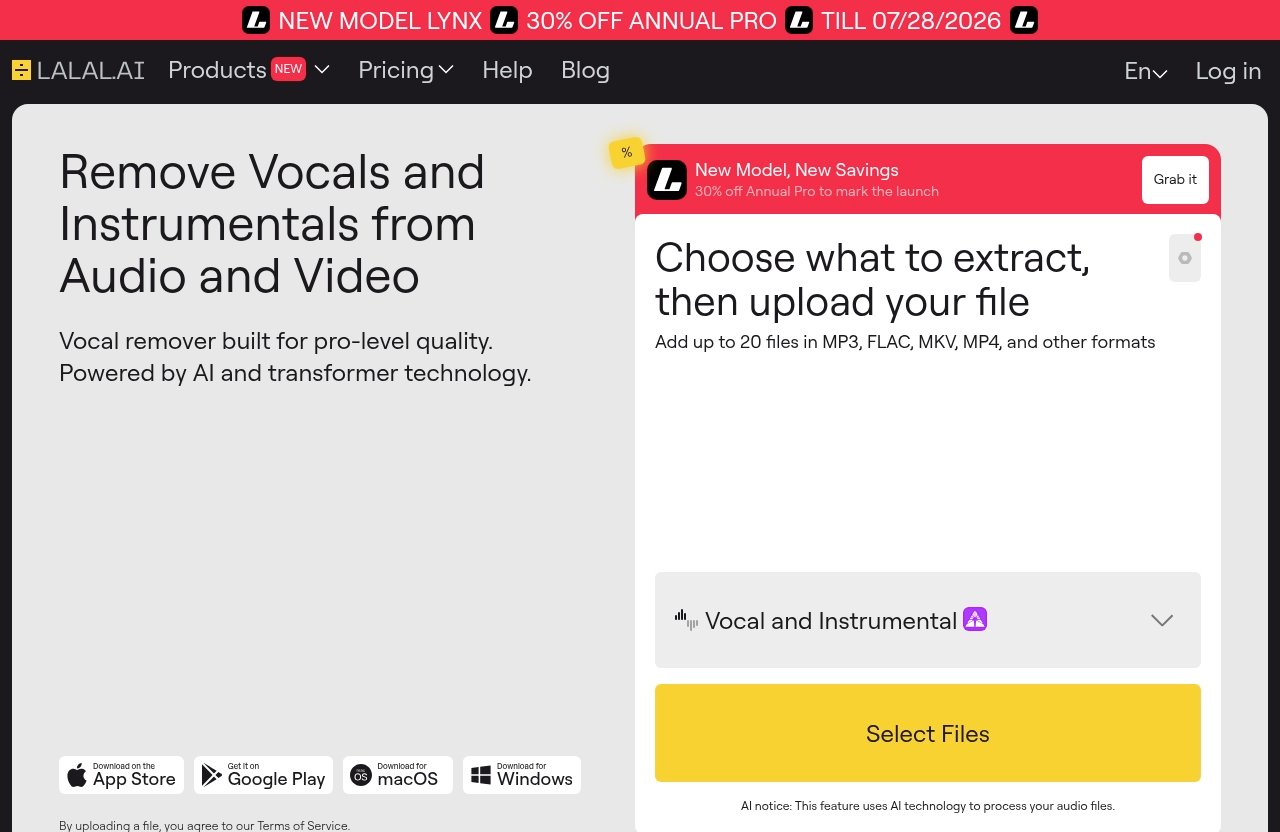
At a high level, the workflow is simple: upload a source file, select the relevant separation process, review the result, and download or work with the separated output where available. The technical challenge happens behind the interface: the system must infer which vocal content belongs to the lead and which belongs to the backing arrangement.
That is different from asking an AI to remove backing vocals from song sections completely. Here, the intended task is to identify two overlapping vocal roles, even when they share pitch range, lyrics, timing, and effects.
Upload workflow and output stems
The practical workflow begins with a mixed source file. Before committing to any purchase decision, use a representative section of your material rather than an unusually easy verse or a heavily compressed social-media excerpt.
The official Lead/Back Vocal Splitter page describes the product as a way to separate lead and backing vocals. In practical terms, readers should expect the workflow to focus on distinct lead-vocal and backing-vocal outputs rather than a conventional vocal/instrumental pair.
Because download options and available formats can change, confirm the current output choices directly during upload or on the live product page. This matters if your project requires a particular file type, sample rate, or DAW workflow.
What LALAL.AI says about the AI separation model
LALAL.AI says its Lead/Back Splitter separates lead and backing vocals with pinpoint accuracy. That is a clear official positioning statement, and it explains why the tool is relevant to users who need more detail than an ordinary vocal remover provides.
However, “pinpoint accuracy” should be tested against your own definition of success. A backing stem can be highly useful for rehearsal while still containing faint lead leakage. A remix producer may require much cleaner separation, especially if the extracted part will be exposed in a new mix.
My practical standard for evaluating a lalal.ai backing vocals result is not whether it sounds technically isolated in solo. It is whether the stem works in context without obvious lead ghosts, watery consonants, or instrumental residue that becomes distracting after processing.
Supported devices and ecosystem: web, desktop, mobile, plugin, API
The official homepage lists a broad platform ecosystem:
| Platform or Integration | Verified Official Availability |
|---|---|
| Desktop apps | Windows, macOS, and Linux |
| Mobile apps | iPhone and iPad; Android phones and tablets |
| DAW integration | VST Plugin that runs locally inside the DAW |
| Developer access | API for developers |
This flexibility is useful for different types of users. A hobbyist may prefer the web or mobile workflow, while a producer handling recurring sessions may care more about the locally running VST plugin. Developers can also explore the API for custom workflows.
The platform list does not guarantee identical workflow options across every environment. Check the relevant product page before planning a batch-processing or studio workflow around it.
Backing Vocal Separation Quality: What LALAL.AI Backing Vocals Does Well
The best-case scenario for lalal.ai backing vocals is a well-defined mix where the lead is clearly dominant and the support parts occupy recognizable positions around it. The more distinct the roles are in timing, register, tone, panning, or arrangement, the more material an AI system has to work with.
This does not mean a track needs to be sparse. It means the vocal architecture needs enough separation for the model to identify a main performance and supporting performances as different musical functions.
Clean pop vocals with obvious backing layers
Contemporary pop often offers favorable conditions when the lead vocal remains dry, centered, and clearly louder than the harmony layers. Background parts may be wider, quieter, higher, lower, or limited to selected words at the end of phrases.
In those situations, a lalal.ai vocal splitter can be particularly useful for extracting chorus support, phrase doubles, and hook accents. A small amount of lead residue may remain, but the output can still be musically informative or usable for a rough creative purpose.
Songs with clean vocal production also make it easier to assess results fairly. If you hear distortion or smeared sibilance, you can more confidently attribute it to separation processing rather than a noisy original master.
Simple harmonies and doubled choruses
Two-part and three-part harmonies are generally more manageable than large vocal stacks. When a lead sings one melody while other parts hold clearly different notes, the distinction is more audible.
Doubled choruses can also be a good use case when the doubles are treated as support rather than as indistinguishable copies of the lead. If they are panned or differently processed, the split may preserve enough of the backing layer to be helpful for learning or rearranging.
For producers studying vocal construction, these lalal.ai stems can reveal practical information: where the chorus begins to widen, which words receive reinforcement, and how long harmonies are held. Treat that information as an approximation, since the extracted output may not perfectly reflect every original track.
Use cases where the back-vocal stem is usable out of the box
A backing stem is often usable immediately when the goal is low-risk and musical rather than forensic. Examples include:
- Singing along with a rough harmony guide
- Referencing chorus voicings before recreating them
- Building a non-commercial demo remix
- Identifying likely ad-lib placement
- Reducing the prominence of the lead for practice
- Creating an educational arrangement example
If you need a polished commercial vocal stem, plan to listen critically and possibly apply manual editing, EQ, de-essing, spectral repair, or selective muting. Our overview of [professional-mix quality after track splitting](/professional-mix-quality-track-splitting/) explains why even a strong AI result is not automatically equivalent to original multitrack audio.
Where LALAL.AI Struggles With Choirs and Layered Vocals
Any fair answer to “is lalal.ai good for backing vocals?” needs to address hard material, not just favorable pop mixes. Choirs, stacked harmonies, and dense effects are difficult because the musical boundary between lead and backing vocals may be unclear even to a human listener.
A model can only separate what the completed mix preserves. Once several voices share the same timing, frequency range, reverb field, and stereo position, there may be no perfectly clean dividing line left in the stereo master.
Dense choir stacks and gospel arrangements
Lalal.ai choir separation is likely to be most challenging when many singers perform similar parts at once. Gospel arrangements, cinematic choirs, worship music, and large pop choruses can combine unison singing, octave layers, improvised responses, and sustained pads.
In those cases, the lead may blend into the choir on purpose. The output can contain lead remnants in the backing stem or remove meaningful choir information along with the lead. This is not necessarily a flaw unique to one tool; it is a limitation of trying to reconstruct separate sources from a completed mix.
For choir material, judge success by whether the extracted layer supports your goal. A slightly imperfect choir bed can be useful for study or rehearsal, but not necessarily for an exposed remix intro or a release-quality sample.
Overlapping ad-libs, harmonies, and vocal effects
Ad-libs are notoriously ambiguous. A singer may place them behind the lead in volume but keep them in the same pitch range and stereo position. Some ad-libs are also processed with the same delay, reverb, saturation, and tuning treatment as the main vocal.
Lalal.ai layered vocals may therefore move unpredictably between outputs. A harmony might remain mostly intact while a related ad-lib is split across both parts. Doubles that are almost sample-aligned with the lead can be interpreted as part of the main performance rather than as backing support.
Effects create another complication. Reverb tails and delays often contain information from both lead and backing parts. Removing one role cleanly can leave chopped tails, swirls, or a momentary “underwater” texture around consonants.
When artifacts and bleed matter more than stem count
A tool can provide two output stems and still not solve the production problem. The important question is whether the unwanted content is audible at the point where you intend to use the file.
Listen especially for:
- Lead-vocal words leaking into the backing output
- Harmony fragments appearing in the lead output
- Cymbals, guitars, or synths appearing during vocal gaps
- Phasey or metallic texture on sustained vowels
- Missing consonants and blurred “s,” “t,” and “k” sounds
- Pumping, chirping, or sudden changes in ambience
If the backing part will sit quietly beneath a new mix, minor artifacts may be acceptable. If it will be soloed, sampled, or heavily compressed, those same artifacts can become much more obvious. This is one of the main [limitations of AI track splitting](/ai-track-splitting-limitations/) to understand before relying on any separation tool.
Official website · Latest pricing & offers
Real-World Test Framework for Evaluating Backing Vocal Isolation
The most reliable lalal.ai backing vocals assessment comes from testing your own files. A short preview can tell you more than broad marketing language because every arrangement has a different amount of vocal overlap.
Use at least three representative moments: a sparse verse, a full chorus, and the densest section of the song. If the result is only clean in the verse, it may not meet your real need.
What to listen for in previews
Start by listening to the backing-vocal output on headphones. Focus on the points where lead and backing singers overlap, because those moments expose the splitter’s decision-making most clearly.
Then ask:
- Can you hear the intended harmonies as complete musical phrases?
- Does the lead lyric remain obvious in the backing stem?
- Are backing voices cut off at the start or end of words?
- Does the sound remain stable when the arrangement becomes loud?
- Are reverb tails natural enough for your intended use?
Next, listen in mono. Stereo width can disguise leakage, while mono playback makes centered lead-vocal residue easier to notice.
How to judge bleed, phase issues, and artifacts
Bleed is not always a failure. A faint trace of the lead may be irrelevant for practice tracks, but unacceptable for a remix where you need only the harmony stack.
Phase issues are different: they can make a vocal feel hollow, moving, or unstable. Check sustained notes, especially unison doubles and choir vowels. If the tone seems to collapse or shift when summed to mono, the separated output may need more work than it is worth.
Artifacts often appear most clearly after common processing. Try gentle EQ, compression, and level adjustment in your DAW. If the output becomes harsh or synthetic after modest processing, it may not be a strong foundation for a finished production.
A simple scoring rubric for readers to test their own files
Score each category from 1 to 5, where 1 is poor and 5 is excellent:
| Criterion | What a High Score Sounds Like |
|---|---|
| Separation clarity | Lead and backing roles are easy to distinguish |
| Residual lead leakage | Very little intelligible lead remains in the backing output |
| Instrumental contamination | Minimal music appears in vocal-only sections |
| Vocal naturalness | Consonants, breaths, and held notes remain coherent |
| Remix usefulness | The stem can be used without extensive repair |
| Practice/reference usefulness | The arrangement is clear enough to learn from |
A total of 24 to 30 suggests a strong match for your purpose. A score around 16 to 23 may still be worthwhile for reference extraction. Below that, a manual workflow or access to original stems is usually the more efficient option.
Pricing and Plans: What You Can Verify Before Buying
Pricing should be considered in relation to your actual workload. A producer separating a few songs for arrangement study has different value criteria than an editor or content team processing material regularly.
The official site confirms a Plans & Extras pricing section and an Enterprise Solution. Since specific current prices, credits, limits, and included features should be verified on the live page, do not rely on third-party screenshots or outdated reviews.
Official plan page and extras
Before purchasing, visit the live LALAL.AI pricing page and confirm the current plan details yourself. Review available processing access, any extras, and the terms that apply to your intended workflow.
This is particularly important if you need the lalal.ai lead and back vocal splitter repeatedly. A plan that makes sense for one experimental track may not offer the same value for a full catalog of choir-heavy recordings.
Why pricing context matters for a single-feature review
The service includes several audio tools, but not every user needs the broader product family. If backing-vocal separation is your only goal, calculate value based on the number of tracks you realistically expect to process and the percentage likely to yield usable results.
Dense material changes the equation. If only some songs in your library have clearly separable lead and backing parts, test those first before committing to a larger workflow. For more planning considerations, see our guide to (/audio-splitter-pricing-value/).
Best way to decide whether the plan is worth it
Use a simple decision process:
- Select two or three representative tracks.
- Include your hardest material, not only easy songs.
- Evaluate the output using the scoring rubric above.
- Decide whether the result saves enough time compared with manual reconstruction.
- Confirm current pricing and plan terms directly on the official site.
For occasional users, one successful extraction may justify trying the workflow. Frequent users should prioritize consistency, local workflow compatibility, and whether the outputs survive their normal DAW processing.
Best Alternatives if You Need Cleaner Choir Separation
There is no universal “best” choice for choir-heavy material because the best workflow depends on how exposed the final vocal part needs to be. If you need a fast starting point, AI separation is convenient. If you need archival or release-quality isolation, manual work often remains essential.
This is not a case where more stem count automatically means more usable audio. The goal is a musically clean result, not merely a file labeled “backing vocals.”
When to stay with LALAL.AI
Stay with LALAL.AI when your tracks have a distinct lead singer, clear harmony placement, and a use case that tolerates modest cleanup. It is also a practical option when you want to test ideas quickly across desktop, mobile, DAW, or developer workflows.
For straightforward lalal.ai backing vocals tasks, speed is part of the value. If the output helps you hear the arrangement, create a practice reference, or launch a remix draft, it may be doing exactly what you need.
When to compare other stem splitters
Compare other workflows when choir separation is your core commercial requirement rather than an occasional creative convenience. You may also want alternatives if your material consistently contains dense ensembles, heavily reverberant vocals, live recordings, or many tightly aligned doubles.
Avoid comparing tools solely through generic marketing examples. Use the same source section, playback chain, and scoring rubric across every option. That is the only realistic way to compare lead vs backing vocals AI results fairly.
Why backing-vocal separation is still a specialist task
Separating an instrumental from an acapella is already complex. Separating the acapella into lead, harmony, doubles, ad-libs, and choir layers is more nuanced because those elements are intentionally designed to blend.
The more a production succeeds artistically at blending voices, the harder it may be to unblend later. Original multitracks remain the gold standard, while AI should be viewed as an efficient reconstruction tool with variable results.
Final Verdict: Is LALAL.AI Good for Backing Vocals in 2026?
Yes—with an important qualification. Lalal.ai backing vocals separation appears most promising for songs with obvious lead/backing contrast: clean pop leads, distinct supporting harmonies, widened chorus doubles, and arrangements where the backing parts do not fully merge with the lead.
For choir-style productions, gospel stacks, saturated ad-libs, and heavily layered vocal beds, results are less predictable. Expect some bleed, missing fragments, or processing artifacts, and treat the output as a practical starting point rather than a guaranteed replacement for original stems.
Short answer by user type
Producers and remixers can benefit when they need fast arrangement insight or a workable rough stem. Singers and educators may find it especially useful for hearing harmony structure and creating practice materials.
Editors should evaluate the output more strictly if dialogue-like clarity or isolated words matter. Hobbyists may get plenty of value from a good result, provided they choose suitable tracks and avoid expecting perfection from difficult mixes.
Who should buy or try it first
Try LALAL.AI first if you work with vocal-forward songs where the lead is clearly distinguishable from the supporting parts. It is also worth exploring if you need flexible access through desktop apps for Windows, macOS, or Linux; iPhone and iPad; Android phones and tablets; a locally running VST plugin; or an API.
Use your own most representative files as the deciding test. A good lalal.ai review 2026 conclusion should always be source-dependent: clean arrangements can produce helpful results, while dense vocal architecture requires more caution.
Who should be cautious
Be cautious if your project depends on flawless choir extraction, isolated unprocessed harmonies, or commercial-release-ready stems with no cleanup. You should also be careful when the lead and backing singers perform identical lines in the same register with similar effects.
The concise recommendation is this: LALAL.AI is worth trying for backing-vocal separation when you have clear vocal layering and a realistic use case. For heavily layered or choir-style productions, test before buying and keep a manual cleanup workflow—or original stems—as your fallback.
Official website · Latest pricing & offers
FAQ
Can LALAL.AI isolate backing vocals cleanly?
Yes, on many tracks with clear separation between the main vocal and harmony layers. Results depend heavily on arrangement density, processing, and source quality, so tightly blended vocals may retain lead leakage or artifacts.
Does LALAL.AI work on choir-style vocals?
Sometimes, but choir stacks are among the hardest sources to separate. Expect less predictable results with overlapping harmonies, unison parts, large ensembles, and heavy reverb than with straightforward pop backing vocals.
What outputs does the Lead/Back Vocal Splitter provide?
The official product description presents the tool as separating lead vocals and backing vocals. Confirm the currently available output and download options on the live product page before starting a project with specific format requirements.
Is LALAL.AI good for remixing and practice tracks?
It can be useful for both, especially when the backing-vocal output is clean enough to reveal harmony structure or support a new arrangement. For a polished remix release, evaluate bleed and artifacts after processing in your own DAW.
What devices and integrations does LALAL.AI support?
According to the official homepage, LALAL.AI supports desktop apps for Windows, macOS, and Linux; mobile apps for iPhone, iPad, Android phones, and Android tablets; a VST plugin that runs locally in a DAW; and an API for developers.
Related Reading
- LALAL.AI Acapella Instrumental 2026: A Practical Guide to Vocal and Music Splits
- Lalal.AI Professional Mixes: Is It Good Enough for Studio Work in 2026?
- Lalal.AI Limitations in 2026: What It Cannot Do Well Before You Buy