
If you make beats, remix records, flip samples, or need clean-ish stems fast, this lalal.ai review for producers comes down to one question: does LALAL.AI save enough time and deliver enough usable stem quality to justify the subscription?
My short verdict: LALAL.AI is a strong tool for fast creative separation, remix prep, vocal removal, and production cleanup. It is not a magic replacement for original multitracks, and dense mixes can still produce artifacts, but for producers who regularly need stems, it can be a serious workflow accelerator.
Disclosure: splitthetrack.com may earn a commission if you purchase through our affiliate link. That does not change the price you pay or the editorial view in this review. You can check the official tool here: LALAL.AI.
Official website · Latest pricing & offers
LALAL.AI at a Glance for Producers
What LALAL.AI does
LALAL.AI is an AI vocal remover and instrumental isolator powered by AI and transformer technology. For producers, the main appeal is simple: upload or process a track, split it into usable parts, and move faster than you would with manual editing or traditional EQ-based extraction.
The official toolset includes Vocal Remover, Stem Splitter, Voice Cleaner, Voice Changer, Voice Cloner, Echo & Reverb Remover, and Lead/Back Splitter. The Stem Splitter can extract vocals, instrumental, drums, bass, guitar, synth, string, and wind instruments.
In practical producer terms, this means you can pull an acapella from a reference, isolate drums from a sample, remove a vocal to create a performance bed, or clean speech and vocal recordings before arranging. This lalal.ai review for producers focuses mainly on those real-world music production uses, not novelty demos.
Who it is best for in a production workflow
LALAL.AI is best for producers who value speed. If you regularly build edits, remixes, mashups, sample packs, reference arrangements, or rough demo stems, it can cut down the time between “I have an idea” and “I can try this in the DAW.”
It is especially useful for:
| Producer Type | Best Use Case |
|---|---|
| Beatmakers | Pulling drums, bass, or melodic material from sample sources |
| Remix artists | Creating fast acapellas, instrumentals, and edit stems |
| Sample flippers | Separating useful musical elements from full mixes |
| Home-studio creators | Cleaning vocals, removing reverb/echo, and preparing rough stems |
| Content-focused musicians | Making quick backing tracks or vocal/instrumental versions |
Skip it if you only need stems once or twice a year, or if your work requires legally cleared, mix-ready multitracks with no bleed. AI stem separation is powerful, but it still depends heavily on the source material.
Quick verdict: worth it or not? A lalal.ai review for producers takeaway
For regular producers, LALAL.AI is worth considering because it solves a common bottleneck: getting workable stems quickly. The value is strongest when you use it every week for remix prep, sample exploration, vocal cleanup, or arrangement testing.
For occasional users, the subscription question is more complicated. If you only split a few tracks a month, you should compare the current cost against how much time it actually saves you.
My practical verdict in this lalal.ai review for producers: buy if stem separation is part of your recurring workflow; skip or wait if you only need a one-off acapella once in a while.
How LALAL.AI Fits a Producer Workflow
Fast idea capture and reference tracking in a lalal.ai review for producers context
The biggest advantage of LALAL.AI is momentum. In a real production session, the first version of an idea often matters more than technical perfection.
Say you hear a hook, drum break, or bass movement in a track and want to test it against your own beat. Instead of spending half an hour filtering, phase-canceling, or searching for unofficial acapellas, an AI stem separator gives you a fast starting point.
That does not mean every output will be final-release ready. But for writing, arrangement, reference tracking, and rough production decisions, speed is a creative advantage.
This is where LALAL.AI fits well: early in the session, when you are trying ideas quickly. If the concept works, you can later refine, re-record, replay, or replace the separated material.
Stem prep for remixes and edits
For remix artists, LALAL.AI can make the preparation phase much faster. You can separate vocals from an instrumental, pull a rough drum stem for reference, or create an instrumental bed for an edit.
The key is to treat the output as production material, not as guaranteed studio multitracks. A separated vocal may still have traces of cymbals, reverb tails, or harmonic bleed. A drum stem may have tonal leftovers from the bass or synths.
That said, many remix workflows do not need perfect isolation at the start. They need something musical enough to build around. This is where a vocal remover for producers becomes genuinely useful.
In my own evaluation approach, I listen for four things before committing a separated stem to a project: timing integrity, artifact level, transient clarity, and whether the bleed will be masked by the new arrangement. If those pass, the stem is often good enough for creative use.
Sample flipping and crate-digging workflows
Sample flipping is one of the strongest use cases for LALAL.AI. When digging through old records, loops, or full mixes, you are often hunting for one usable element: a bassline, guitar phrase, string texture, vocal ad-lib, or drum groove.
The lalal.ai stem splitter can help separate those elements enough to test them in a beat. You might isolate a guitar stem, pitch it down, chop it, and layer it under new drums. Or you might extract a bass part, resample it, then use sidechain, saturation, and filtering to make it sit in a new context.
The important production mindset is this: the separated file does not have to be pristine if you plan to transform it. Artifacts that are obvious soloed can disappear once you chop, filter, reverse, stretch, distort, or bury the sample in a full arrangement.
For sample flippers, this lalal.ai review for producers leans positive because creative processing often hides the imperfections that would matter more in a clean acoustic remix.
Using it with DAWs, the desktop app, and plugin integrations
LALAL.AI offers desktop apps for Windows, macOS, and Linux, plus iOS and Android apps. That is useful if you move between studio sessions, laptop sketching, and mobile idea capture.
The official lineup also includes a VST plugin that runs locally inside your DAW. For producers, that matters because the least inspiring part of stem separation is often file management: exporting, uploading, downloading, naming, importing, and lining everything up again.
A lalal.ai plugin can make the process feel closer to a normal production step. If you can audition or process stems from inside your DAW workflow, you reduce friction and keep the session moving.
There is also an API for developers, which matters more for studios, platforms, or custom tool builders than individual beatmakers. Still, it shows that LALAL.AI is not limited to a single web-upload workflow.
Stem Quality: What You Can Expect in 2026
Vocal separation quality
Vocal separation is still the headline use case for most producers. A good vocal extraction can unlock remixes, edits, DJ tools, bootlegs, writing references, and topline studies.
On clean, modern mixes with centered vocals and balanced instrumentation, AI vocal separation can be very usable. The vocal may retain some reverb, delay, or background elements, but it can often sit inside a new beat with additional processing.
Where quality becomes more fragile is in dense mixes. If vocals are heavily layered with synths, distorted guitars, cymbals, crowd noise, or stereo effects, separation becomes harder. You may hear watery textures, phasey tails, missing consonants, or musical bleed.
For this lalal.ai review for producers, the important point is not whether every vocal is perfectly isolated. It is whether the result is good enough for the task: remix sketch, sample chop, clean edit, backing track, or release-ready production.
Drums, bass, guitar, synth, string, and wind extraction
LALAL.AI’s Stem Splitter can extract vocals, instrumental, drums, bass, guitar, synth, string, and wind instruments. That gives producers more creative options than a basic vocal/instrumental split.
Drum extraction is useful for groove study, remix timing, and sample layering. Bass extraction can help identify low-end movement or create a starting point for resampling. Guitar, synth, string, and wind extraction can be valuable for melodic sampling and arrangement reference.
The quality depends on how clearly those instruments are separated in the original mix. A dry bassline in a sparse track is easier to isolate than a bass buried under kick, synth, and distortion. A solo guitar phrase will usually separate more cleanly than guitar strums blended into a wide rock mix.
Think of lalal.ai stem quality as source-dependent. The better the original mix and the more distinct the target part, the more useful the extracted stem is likely to be.
Artifacts, bleed, and when quality drops
Every AI stem separator has limits. With LALAL.AI, the producer should listen for the same issues that matter in any stem workflow: artifacts, bleed, transient smear, phase weirdness, and loss of high-frequency detail.
Common problem areas include cymbals bleeding into vocals, vocals leaving ghost-like traces in instrumentals, kick and bass confusing the low-end split, and reverb tails sounding unstable. These issues are not always deal-breakers, but they affect how you use the output.
A separated vocal with light cymbal bleed may still work in a loud club remix. A drum stem with tonal artifacts might be fine once layered under new drums. But an exposed acoustic intro or sparse vocal breakdown will reveal flaws quickly.
This is why producers should judge outputs in context. Soloing a stem is useful for diagnosis, but the real test is whether it works inside your arrangement.
Best file types and source material for cleaner results
Source quality matters more than many beginners expect. A heavily compressed MP3, noisy live recording, phone capture, or badly mastered track gives the AI less clean information to work with.
For better results, start with the cleanest source you legally have access to. Lossless or high-quality files generally give separation tools more detail than low-bitrate sources. Clean mixes, strong vocal presence, and less overlapping instrumentation usually produce better stems.
Avoid expecting miracles from distorted, clipped, or extremely dense material. LALAL.AI can still produce creatively useful results, but the output is more likely to need repair, masking, or resampling.
My practical test is simple: if the original track already sounds smeared, crushed, or noisy, I expect more cleanup work after separation. That expectation keeps the lalal.ai review for producers balanced: the tool is useful, but the source file still sets the ceiling.
Features That Matter Most to Producers
Stem Splitter and Vocal Remover
Stem Splitter and Vocal Remover are the core features for music production. Vocal Remover is the obvious choice when you need an acapella or instrumental version quickly.
Stem Splitter is broader. It lets you target specific musical elements such as drums, bass, guitar, synth, string, and wind instruments, in addition to vocals and instrumental output.
For producers, this opens more creative paths. You can build remixes from partial stems, extract musical fragments for sampling, or analyze arrangements by listening to separated parts.
The best way to use these tools is not to expect perfect studio stems every time. Use them as fast production inputs, then apply your normal producer tools: EQ, fades, gating, noise reduction, saturation, transient shaping, and layering.
Voice Cleaner and Echo & Reverb Remover
Voice Cleaner is useful when you are dealing with vocal recordings that need cleanup before editing, chopping, or placing in a beat. For home-studio creators, this can help when recordings are imperfect but still worth saving.
Echo & Reverb Remover is also relevant for producers. Reverb-heavy vocals can be difficult to remix because the original room or delay tail fights the new instrumental. Reducing that ambience can make a vocal easier to fit into a fresh production.
These tools do not replace a full manual mix repair process, but they can speed up rough cleanup. If you are producing demos, social content, reference vocals, or quick collaborations, that time saving can matter.
For surgical restoration, you may still want a more specialized workflow. But for creative music production, fast cleanup is often enough to keep the session alive.
Lead/Back Splitter for layered vocals
Lead/Back Splitter is one of the more producer-relevant features because modern vocals are often stacked. Leads, doubles, harmonies, ad-libs, and background vocals can create problems when you only want the main performance.
If you are remixing, a lead vocal separated from background layers gives you more control over arrangement and drop placement. If you are studying vocal production, separating lead and backing parts can also help you understand how the original record was built.
This kind of tool is especially useful for pop, R&B, hip-hop, EDM, and vocal-heavy sample work. Layered vocals can be difficult to manage when treated as one flat acapella.
As always, quality depends on the original mix. But when it works, Lead/Back Splitter can save a lot of manual editing time.
Desktop apps, mobile apps, VST plugin, and API
LALAL.AI supports multiple working styles. The desktop apps cover Windows, macOS, and Linux. Mobile apps are available for iOS and Android. The VST plugin runs locally inside your DAW, and the API is available for developers.
That range matters because producers do not all work the same way. Some want a desktop utility for batch-style prep. Others want DAW integration. Some capture ideas on mobile and finish them later in a studio session.
For me, the DAW angle is the most important. If a tool stays close to the creative environment, I am more likely to use it consistently. A stem separator that requires too many extra steps can become something you only use when absolutely necessary.
This lalal.ai review for producers gives extra weight to workflow compatibility because speed is one of the main reasons to use the tool in the first place.
Official website · Latest pricing & offers
LALAL.AI Pricing and Subscription Value
Official plans and extras
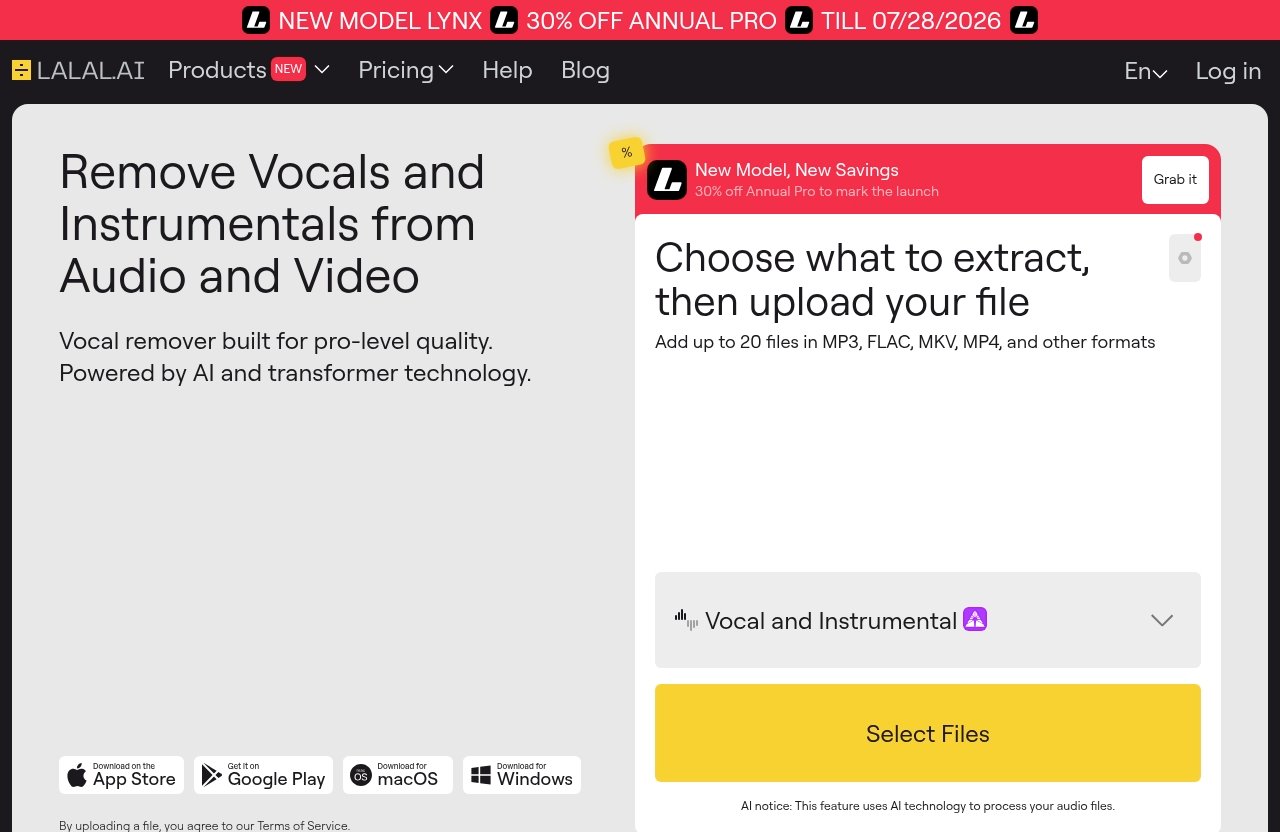
LALAL.AI pricing should be checked on the official pricing page before you buy, because exact prices, plan names, limits, and included allowances can change. I am not listing unverified numbers here because producer budgeting depends on accurate current information.
The official pricing excerpt available for this review includes a promotional message: “NEW MODEL LYNX” and “30% OFF ANNUAL PRO TILL 07/28/2026.” If you are comparing annual versus monthly value, verify that promotion and the current plan details directly on the live pricing page.
You can review the current official pricing through LALAL.AI before making a decision.
The main point: do not judge lalal.ai pricing only by the headline price. Judge it by how many real production problems it solves for you each month.
How to judge value by monthly usage
The subscription value depends on your usage pattern. A producer who separates stems daily will judge LALAL.AI very differently from someone who needs one vocal extraction every few months.
Ask yourself:
| Question | Why It Matters |
|---|---|
| How many tracks do I process per month? | Frequent use makes recurring payment easier to justify |
| Do I use stems for paid work? | Client edits, remixes, and production services can offset cost |
| Do I need DAW integration? | Plugin workflow can save time during active sessions |
| Are my sources usually clean? | Better sources improve the chance of usable output |
| Do I need final stems or creative starting points? | Expectations affect perceived value |
If LALAL.AI saves you an hour every week, the value may be obvious. If it saves you ten minutes once a month, the subscription is harder to justify.
When a subscription makes sense vs one-off usage
A lalal.ai subscription makes the most sense for producers who regularly process songs, samples, vocals, or reference tracks. Remix artists, sample flippers, editors, and content producers are the most likely to benefit.
It may not make sense if your workflow is mostly original recording and you already have access to multitracks. If you produce everything from scratch, you may only need stem separation occasionally.
For occasional users, the best approach is to check the current pricing, estimate your monthly processing needs, and compare that against alternatives. Do not pay for a subscription just because the technology is impressive.
This lalal.ai review for producers is positive on value for regular users, but cautious for casual users.
Promo period and annual discount considerations
The official pricing excerpt mentions “30% OFF ANNUAL PRO TILL 07/28/2026.” If that promotion is still active when you read this, annual billing may improve the value for producers who already know they will use LALAL.AI consistently.
However, annual discounts only make sense if your workflow supports them. If you are unsure whether you will use the tool long-term, test the workflow first and confirm the current cancellation, billing, plan, and allowance details on the official pricing page.
Do not choose annual pricing just because it looks cheaper per month. Choose it because you have recurring production needs: remixes, stems, sample prep, cleanup, or DAW-based separation.
The right decision is not “annual is better” or “monthly is safer.” The right decision is whether the amount of music you process justifies the commitment.
Pros and Cons for Music Producers
Strengths
LALAL.AI’s biggest strength is speed. It helps producers move from source material to workable stems quickly, which is exactly what you want during early creative stages.
It also offers a broad set of producer-relevant tools. Stem Splitter, Vocal Remover, Voice Cleaner, Echo & Reverb Remover, Lead/Back Splitter, desktop apps, mobile apps, a VST plugin, and API support make it more than a basic acapella maker.
The stem options are useful for real production decisions. Being able to target vocals, instrumental, drums, bass, guitar, synth, string, and wind instruments gives producers more ways to experiment.
The tool is especially strong when the goal is creative transformation. If you plan to chop, layer, resample, filter, or remix the output, minor imperfections are often manageable.
Limitations
The main limitation is that AI stems are not original multitracks. If the original mix is dense, distorted, noisy, or heavily mastered, artifacts and bleed can become more noticeable.
Complex songs can produce phasey highs, smeared transients, watery textures, or leftover elements in the wrong stem. These problems are common across AI separation tools, not just LALAL.AI.
Another limitation is value for occasional use. If you only need a few extractions per year, a recurring subscription may not be the best fit.
Finally, separated stems may still need producer cleanup. Expect to use fades, EQ, noise reduction, gating, or creative masking if the output will be exposed in a final arrangement.
Best-case vs worst-case scenarios
Best case: you feed LALAL.AI a clean, well-mixed source with a clearly defined vocal or instrument. The output drops into your DAW quickly, needs light processing, and helps you finish a remix, beat, or edit faster.
Worst case: you process a crushed, noisy, dense track where vocals, cymbals, guitars, and synths all overlap. The output may contain bleed, unstable artifacts, and missing detail.
Most real sessions fall somewhere in the middle. The stems are not perfect, but they are useful enough to build with.
That is the balanced takeaway from this lalal.ai review for producers: LALAL.AI is a practical production tool, not a guarantee of flawless isolation.
LALAL.AI vs Alternatives: When to Choose It
Best for quick stem extraction
Choose LALAL.AI when speed and convenience are the priority. If you need a fast vocal, instrumental, drum, bass, or melodic stem to test an idea, it fits the job well.
It is also a good fit if you want multiple access points: desktop app, mobile app, VST plugin, and API. That flexibility can matter more than tiny quality differences when you are working under time pressure.
Compared with lalal.ai alternatives, the decision should be based on workflow, output quality on your source material, pricing, and integration needs. Do not choose based only on marketing claims.
The best stem separator is the one you will actually use during a session without breaking your creative flow.
When you might want a more advanced restoration suite
If your main work is forensic audio repair, archival restoration, dialogue rescue, or surgical post-production, you may want a more specialized restoration suite. Those tools are often built for deeper manual control.
LALAL.AI is better framed as a producer-friendly separation and cleanup tool. It helps you get usable parts quickly, especially for music creation.
For release-critical audio where every artifact matters, you may need a longer restoration chain. That could include manual editing, spectral repair, re-recording, or alternate sourcing.
In other words, choose LALAL.AI for production speed. Choose a deeper restoration workflow when precision matters more than speed.
When budget or occasional usage changes the decision
Budget changes the recommendation. A daily producer can justify tools that speed up repetitive work. An occasional user should be more selective.
If you only need one or two stems now and then, compare current LALAL.AI pricing with your actual monthly need. Do not subscribe out of curiosity and forget about it.
If you regularly make remixes, sample-based beats, DJ edits, YouTube covers, or client demos, the equation changes. In that case, recurring access to an ai stem separator can be a normal production expense.
For this lalal.ai review for producers, the subscription makes the most sense when stem separation is part of your routine, not a rare emergency.
Final Verdict: Is LALAL.AI Worth It for Producers in 2026?
Who should buy
Producers should buy LALAL.AI if they regularly need fast stems for remixing, sample flipping, vocal removal, instrumental creation, cleanup, or arrangement testing. It is especially useful for creators who value speed and can tolerate minor artifacts when the output is used creatively.
Daily beatmakers, remix artists, sample-based producers, and DAW-focused creators are the strongest fit. The VST plugin, desktop apps, mobile apps, and broader toolset make LALAL.AI practical for different production setups.
If you often lose time trying to find acapellas, isolate samples, or prepare rough stems, LALAL.AI can pay back that time quickly.
Who should skip
Skip LALAL.AI if you only need stem separation once or twice a year. Also skip it if you require perfect multitrack-quality separation from dense commercial masters.
If your source audio is usually low quality, noisy, clipped, or extremely layered, manage expectations carefully. The tool may still help, but you will spend more time cleaning and masking the results.
Producers who already work mostly from original multitracks may not need a recurring stem separator unless remixing and sampling are regular parts of their workflow.
Bottom-line recommendation from this lalal.ai review for producers
The bottom line: LALAL.AI is worth it for producers who use stem separation often enough to benefit from faster workflow, flexible access, and broad stem options. It is strongest as a creative production tool, not as a perfect replacement for original session files.
For occasional users, check the current official pricing and compare it against your real monthly usage before subscribing. For daily producers and remix-focused creators, LALAL.AI is easy to justify if it saves time and keeps ideas moving.
My final lalal.ai review for producers verdict: buy if stems are part of your regular workflow, test carefully if you are budget-conscious, and skip if you need flawless isolation from difficult source material.
Official website · Latest pricing & offers
FAQ
Is LALAL.AI good for producers in 2026?
Yes. LALAL.AI is a strong option for producers who need fast stem separation for remixing, sample flipping, vocal removal, and cleanup.
It is best when workflow speed matters more than surgical restoration. For perfect multitrack-level control, original stems are still better.
How good is LALAL.AI stem quality on complex songs?
LALAL.AI stem quality can be strong on clean, well-mixed material, but complex songs are harder. Dense arrangements, heavy mastering, reverb, cymbals, distortion, and overlapping instruments can increase artifacts and bleed.
The best way to judge quality is to test the stem inside your actual production, not only soloed.
Can I use LALAL.AI inside my DAW?
Yes. LALAL.AI offers a VST plugin that runs locally inside your DAW.
It also offers desktop apps for Windows, macOS, and Linux, mobile apps for iOS and Android, and an API for developers.
Is LALAL.AI worth the subscription for occasional use?
For occasional use, it depends on the current price and how many tracks you process each month. Frequent producers may justify a lalal.ai subscription because it saves time repeatedly.
If you only need a few stems per year, check the official pricing and compare it against your actual processing needs before committing.
What can LALAL.AI split besides vocals?
LALAL.AI’s Stem Splitter can extract vocals, instrumental, drums, bass, guitar, synth, string, and wind instruments.
It also includes related tools such as Vocal Remover, Voice Cleaner, Echo & Reverb Remover, and Lead/Back Splitter, which are useful for producer cleanup and remix workflows.
Related Reading
- Is Lalal.AI Safe to Use in 2026? Privacy-First Safety Check
- Is Lalal.AI Free in 2026? What You Can Actually Do
- How Much Does Lalal.AI Cost in 2026? Lalal.AI Pricing Guide