
Affiliate disclosure: SplitTheTrack.com may earn a commission if you purchase through links in this article, at no extra cost to you. That relationship does not change this editorial assessment.
Official website · Latest pricing & offers
Quick Verdict: Is LALAL.AI Good Enough For Professional Mixes In 2026?
Short Answer For Mix Engineers And Producers: LALAL.AI Professional Mixes
Yes—but with an important qualification. LALAL.AI professional mixes can be useful when you need fast access to vocals, instrumentals, drums, bass, or other extracted elements, but it should not be treated as a replacement for original multitrack sessions.
In practical studio work, the value is usually speed. If a client sends only a stereo file, a producer needs a quick remix acapella, or an engineer wants to examine a reference arrangement, AI separation can turn a dead end into a workable starting point.
That does not mean every extracted stem is ready for release. The better way to think about LALAL.AI professional mixes is as source recovery and cleanup: a tool that helps you make decisions, prepare material, and rescue imperfect files.
If that is what your workflow needs, LALAL.AI is worth testing. If you need surgically transparent stems from dense commercial masters, temper your expectations before buying.
What “Professional” Should Mean Here: LALAL.AI Professional Mixes
“Professional” does not always mean flawless isolation. In a real session, it often means meeting a deadline, creating a convincing demo, producing a remix preview, or cleaning a recording enough to move forward.
For LALAL.AI professional mixes, the realistic standard is whether the separated material is useful in context. A vocal with faint instrumental residue may be perfectly usable for arrangement planning, remix prep, rehearsal playback, or a social edit. It is less suitable as the foundation of a pristine final vocal mix.
The source file remains the biggest variable. A clean, well-balanced stereo mix with a centered lead vocal usually gives an AI separator more to work with than a crushed, reverberant, heavily limited file.
Best-Fit Use Cases Vs. Risky Use Cases
Best-fit scenarios include remix preparation, demo cleanup, reference-track analysis, live-recording repair, quick acapella generation, and separating elements for creative sound design. These are situations where time saved can outweigh minor artifact risk.
Risk rises when the extracted result must survive close solo listening in a commercial release. LALAL.AI professional mixes are most dependable when the separation is part of a larger production process, not the only source for a critical final mix decision.
What LALAL.AI Actually Does For Mix And Mastering Work
Vocal Remover
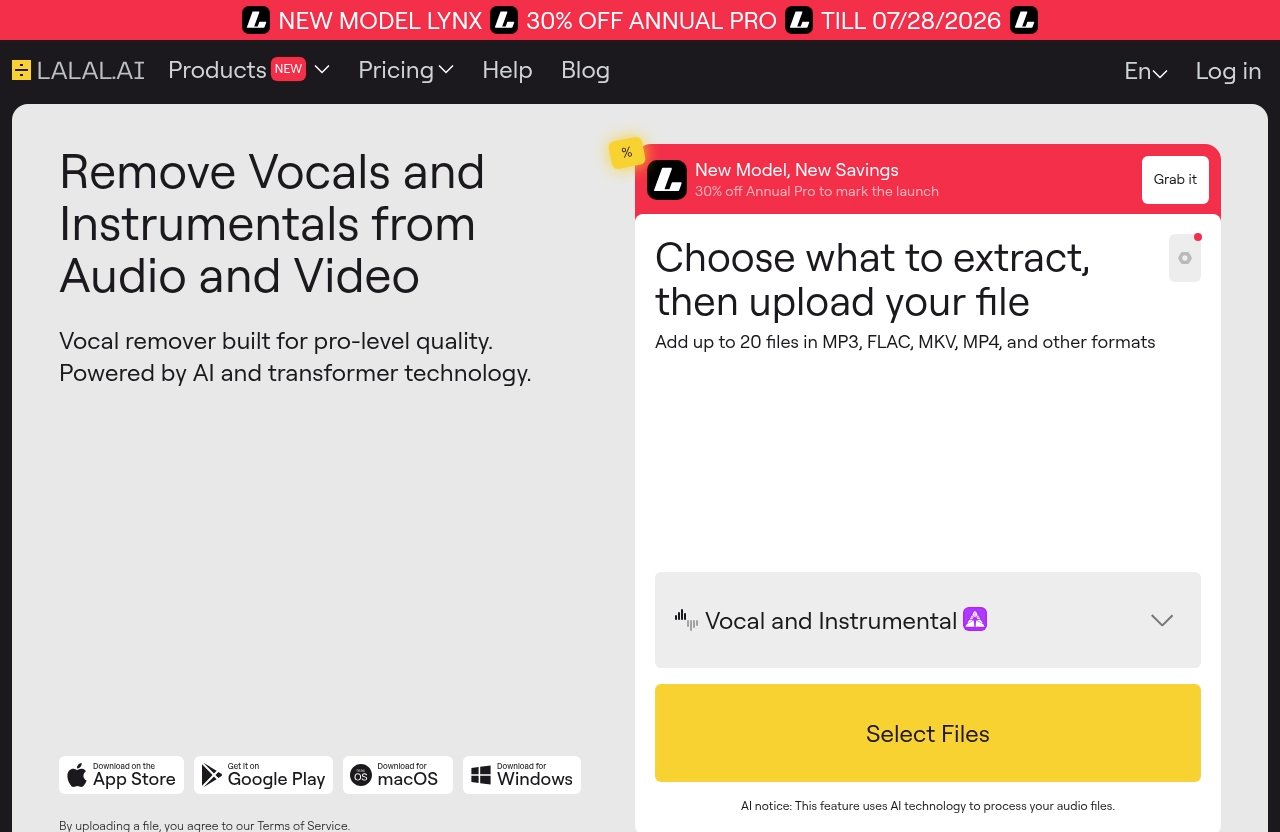
LALAL.AI’s Vocal Remover is designed to remove vocals or instrumentals from music tracks, audio clips, and video. For a producer, that can mean making a quick instrumental for a rehearsal, testing a vocal idea against a reference groove, or preparing a rough remix foundation.
As a vocal remover for mixing, it is most useful when you treat the result as workable material rather than guaranteed transparency. Check the instrumental around snare hits, synth leads, and vocal effects, where traces of the removed element may be more noticeable.
Stem Splitter: LALAL.AI Professional Mixes
The LALAL.AI stem splitter can extract vocals, instrumental, drums, bass, guitar, synth, and string and wind instruments. That range makes it more relevant to engineers than a simple vocal/instrumental splitter.
For LALAL.AI professional mixes, individual targets can support arrangement analysis and repair work. A producer may isolate bass to understand a low-end relationship, pull drums for a remix sketch, or extract guitar before rebuilding a part with a new performance.
The key point is that separated parts are interpretations of a finished mix. They are not the same thing as receiving the original kick, snare, overhead, room, and processed drum tracks.
Voice Cleaner
Voice Cleaner removes background music, vocal plosives, mic rumble, and other unwanted noises. This is especially relevant when a vocal arrives as a field recording, interview capture, rehearsal take, or poorly controlled home-studio file.
Used carefully, it can function as an audio cleanup tool for producers working under time pressure. I would still preserve an untouched original before processing, because aggressive cleanup can alter tone, breath detail, and the natural weight of a voice.
Echo & Reverb Remover
Echo & Reverb Remover is intended to remove echo and reverb from vocals, voice recordings, songs, and videos. In studio terms, that makes it a potential rescue option when a vocal was recorded in an untreated room or printed with ambience that no longer suits the production.
This is not a magic “un-reverb” button. Dense reverberation is woven into the source signal, so results should be reviewed for watery tails, softened consonants, or changes in vocal presence before they become part of LALAL.AI mixing and mastering work.
Lead/Back Splitter: LALAL.AI Professional Mixes
Lead/Back Splitter separates lead and backing vocals. For arrangement decisions, vocal comp planning, and remix preparation, that can be one of the more creatively useful tools in the set.
In LALAL.AI professional mixes, separating leads from stacks can help an engineer hear how much width and support comes from harmonies. It can also reveal whether a chorus needs newly recorded backing parts rather than simply louder lead vocals.
Where Engineers Say It Works Best
Acapellas And Instrumental Extractions For Remix Prep
Remix artists often need an answer quickly: can this vocal work over a new track, and does the original instrumental contain useful rhythmic material? AI audio separation can provide that answer faster than waiting for label assets that may never arrive.
For LALAL.AI professional mixes, this is a strong use case because the extracted vocal will often be layered into a new production. New drums, bass, effects, doubles, and backing elements can mask modest extraction imperfections better than a sparse, exposed arrangement.
This is also why “best stem splitter for remixing” is not always about the cleanest solo stem. It is about whether the separated element behaves convincingly after processing and inside a new mix.
Live Recordings And Rehearsal Captures
Live recordings are rarely perfect. A rehearsal capture may have room reflections, crowd noise, monitor bleed, and a vocal that is difficult to evaluate against the band.
A professional stem separator can help isolate the part that matters most for a decision. For example, a producer might separate the lead vocal to assess melody and phrasing, then ask the artist to re-record only the passages that need work.
Cleaning Reference Tracks And Rough Demos
Reference tracks can be helpful, but they can also be cluttered. Extracting or reducing vocals, drums, or bass lets you focus on a specific arrangement relationship without being distracted by the rest of the production.
LALAL.AI professional mixes are particularly useful for this kind of study. You can investigate the timing of a bass pattern, the density of a chorus vocal stack, or the tonal role of a synth without claiming that the extraction represents the original production session.
For rough demos, the same logic applies. A quick cleanup pass can make a songwriting demo clearer enough for a band, client, or collaborator to understand the intended direction.
Removing Bleed, Noise, And Unwanted Ambience
Voice Cleaner and Echo & Reverb Remover are most useful as repair aids. A spoken intro recorded in a noisy room, a vocal memo with rumble, or a live announcement captured through a poor microphone can often benefit from focused cleanup.
The safest approach is incremental. Process a copy, level-match it against the original, and make sure you are solving a real problem rather than trading noise for unnatural vocal texture.
Lead/Back Vocal Separation For Arrangement Decisions
When a chorus feels crowded, lead/back separation can help reveal why. You may discover that a backing layer is competing with the lead’s consonants, that a harmony is carrying too much low-mid energy, or that the hook needs a clearer center image.
This is a useful production aid even if the result never appears in the finished release. LALAL.AI for engineers makes more sense when viewed as an analysis and preparation tool, not merely an export generator.
Where It Can Struggle In Professional Mixes
Dense Arrangements And Stacked Harmonies: LALAL.AI Professional Mixes
The hardest files tend to contain many overlapping sounds in similar frequency ranges. Stacked harmonies, distorted guitars, bright synth layers, and heavily processed vocals can confuse any separation process.
With LALAL.AI professional mixes, listen for remnants of vocal syllables in an instrumental, missing consonants in a vocal stem, or dullness where overlapping instruments were removed. These issues may be subtle in a full mix but obvious once you compress, brighten, or distort the extracted file.
Heavy Reverb, Room Sound, And Cymbal Wash
Heavy reverb creates overlapping information across time. Cymbal wash creates a similar challenge in the upper frequencies, especially when vocals, guitars, and ambience share the same area of the spectrum.
Expect more risk with arena-style reverbs, wide vocal effects, live rooms, and dense cymbal-heavy arrangements. An extracted vocal may retain pieces of the room, while an instrumental can develop soft swirls or smearing around high-frequency material.
Phase-Sensitive Or Transient-Heavy Material
Drum transients, stereo widening, chorus effects, and phase-dependent processing can be fragile after separation. If you are trying to create a release-ready drum stem from a stereo master, small timing or phase changes can become obvious after parallel compression or limiting.
For LALAL.AI professional mixes, always audition in mono as well as stereo. A result that feels acceptable on headphones can reveal instability when folded down or played through a club-oriented system.
Final-Release Mastering Expectations
Stem separation for mastering has limits. A mastering engineer can use extracted material to diagnose a problem, create a reference, or explore whether a vocal, bass, or drum balance is driving the issue.
But extracted stems should not be assumed to behave like genuine mix stems. For critical mastering revisions, original premaster files and approved mix revisions remain the correct path whenever they are available.
When A Real Multitrack Is Still Required
Original multitracks are still required for detailed corrective work: fixing a clipped vocal phrase, changing drum-gate timing, replacing one backing vocal, altering the amount of vocal reverb, or making precise automation changes.
That is the central reality behind LALAL.AI limitations. AI can separate what is embedded in a stereo file, but it cannot restore every creative and technical option that existed before the mix was printed.
Official website · Latest pricing & offers
Best Workflow For Pro Users: How To Get Cleaner Results
Choose The Right Source File
Start with the cleanest file available. Prefer a high-quality original export over a social-media rip, streaming capture, or file that has already been transcoded several times.
For LALAL.AI professional mixes, avoid processing the source before separation unless necessary. Extra limiting, saturation, widening, or noise reduction can make it harder to distinguish elements cleanly.
Use The Most Suitable Stem Target
Do not split every possible element simply because you can. Decide what you actually need: a lead vocal for remix prep, an instrumental for rehearsal, bass for arrangement analysis, or drums for a quick production sketch.
Choosing the right target reduces unnecessary processing and makes evaluation clearer. If the goal is a vocal extraction, compare a vocal-focused result with a lead/back split rather than assuming one output will fit every arrangement.
Work With Short Sections First
Before processing an entire track, test the chorus, a busy verse, and a transition. Those sections will usually expose the difficult moments: stacked vocals, cymbal-heavy hits, reverberant tails, and dense instrumental overlaps.
This habit saves time and helps set expectations. If a short test is not usable, a full-length export is unlikely to solve the underlying source problem.
Compare Multiple Separations
A/B test the extracted file against the original mix at matched volume. Then test it inside the intended production, because a minor artifact that sounds distracting in solo may disappear once new elements are added.
LALAL.AI professional mixes benefit from practical comparison rather than visual assumptions. Listen to important words, kick attacks, bass notes, and high-frequency transitions—not just the overall tone.
Post-Process In Your DAW
Use your DAW to finish the job. High-pass filtering can remove low-end residue from a vocal extraction; dynamic EQ can tame harsh artifacts; manual clip edits can remove problematic moments; and automation can hide a brief flawed phrase more naturally than global processing.
For remix prep, align the extracted acapella to your session grid and correct obvious timing issues manually. For live-recording rescue, use cleanup before tasteful EQ and compression. For vocal extraction, avoid over-compressing artifact-heavy phrases, because compression can make imperfections more obvious.
The locally running VST Plugin may suit users who prefer to keep the process inside a DAW. Desktop apps are also available for Windows, macOS, and Linux, while mobile apps are available for iPhone, iPad, and Android devices.
Pricing And Plans: What Matters For Professionals
Which Plan Type Makes The Most Sense For Studios
Current LALAL.AI pricing should be checked directly on the official pricing page, because the verified information available for this review does not list current plan names, usage allowances, or prices.
For a studio, the practical question is not simply the entry cost. Consider how often you receive stereo-only files, how many client revisions involve missing assets, and whether separation will be a recurring service or an occasional emergency tool.
When Extra Usage Is Worth It
Higher usage is easier to justify when you regularly prepare remixes, restore vocal material, build rehearsal resources, or analyze references. It is harder to justify when you only need one isolated stem every few months.
Think in terms of avoided labor. If a few quick separations prevent hours of manual editing, rescheduling, or rebuilding a rough arrangement, the tool may pay for itself through time saved.
Why Pricing Should Be Judged Against Time Saved
A good LALAL.AI professional mixes purchase decision is based on workflow value, not promises of perfect extraction. The platform also offers a locally running VST Plugin and an API for developers, which may matter more to high-volume users than a one-off web workflow.
Before committing, review the current plans and test the exact type of source material you actually handle. A clean pop vocal, a live band recording, and a dense electronic master can produce very different outcomes.
LALAL.AI Vs The Alternatives A Pro Should Consider
When Speed Matters More Than Surgical Perfection
If you need usable material quickly, AI stem separation for professionals is often the right category of solution. The useful question is whether the output gets you to the next production decision faster.
LALAL.AI professional mixes can be a strong option when speed, accessibility, and broad extraction targets matter more than forensic-grade isolation. It is especially practical for prep work that will be followed by editing, replacement recording, or a fresh remix arrangement.
When You Should Compare Against Other Stem Splitters
Compare tools using your own difficult material, not only an easy vocal-pop excerpt. Test a busy chorus, a live recording, a track with wide effects, and a file with heavy low end.
Listen for the artifacts that matter in your workflow. One engineer may prioritize clean lead vocals, while another needs dependable drum extraction or fast instrumental removal for remix previews.
When Manual Editing Still Wins
Manual editing wins when the source is short, the required correction is highly specific, or the original production assets exist. It also wins when you need exact edits with no uncertainty around phase, ambience, or transient detail.
The smartest workflow is often hybrid: use AI to create a fast starting point, then use traditional editing, replacement parts, and DAW processing to make the result fit the project.
Who Should Buy It And Who Should Skip It
Mix Engineers: LALAL.AI Professional Mixes
Mix engineers should consider it for emergency source recovery, client demo cleanup, reference analysis, and remix preparation. It is useful when a missing asset is blocking progress and a good-enough extracted element can move the session forward.
Skip it as a substitute for requesting proper multitracks. LALAL.AI professional mixes can support a mix workflow, but they should not redefine the technical standard for deliverables.
Mastering Engineers
Mastering engineers may find value in diagnostic listening, quick reference cleanup, and understanding what is contributing to a balance problem. It can be useful for investigation, not for replacing approved mix stems.
If a mastering revision requires real control over vocals, drums, or instrumentation, request a revised mix or original stems instead.
Producers And Remix Artists
Producers and remix artists are among the strongest-fit users. Fast vocal and instrumental preparation can unlock ideas that would otherwise stay on hold.
The tool is particularly attractive when an extracted part will be transformed, layered, chopped, filtered, or supported by newly produced elements. That context is more forgiving than a naked solo vocal release.
Podcasters And Content Teams
Voice Cleaner, Vocal Remover, and Echo & Reverb Remover can be useful for cleaning voice-focused material, background audio, and rough video sound. Content teams should still review results carefully before publishing, especially around speech clarity.
Students And Hobbyists
Students and serious home-studio users can learn a great deal by separating references and studying arrangement roles. They should avoid confusing extracted stems with original production quality, but the educational and creative value can be substantial.
Final Verdict: The Honest Pro-Mix Takeaway
Best Reasons To Buy
Buy if you regularly need fast stem preparation, vocal cleanup, arrangement analysis, remix material, or rescue options for imperfect stereo files. The combination of Vocal Remover, Stem Splitter, Voice Cleaner, Echo & Reverb Remover, and Lead/Back Splitter covers several real-world studio problems.
For LALAL.AI professional mixes, the biggest benefit is time. It can turn “we only have a stereo file” from a full stop into a workable production path.
Best Reasons Not To Buy
Do not buy expecting original multitrack quality from every song. Dense arrangements, stacked harmonies, heavy reverb, cymbal wash, transient-heavy material, and phase-sensitive mixes can expose artifacts that are unacceptable for critical release work.
Also skip it if your workflow already has reliable access to clean multitracks and you rarely need cleanup or remix preparation.
Bottom-Line Recommendation: LALAL.AI Professional Mixes
The honest verdict is that LALAL.AI professional mixes hold up best as a practical assistant for engineers and producers—not as a miracle replacement for source files that no longer exist. It is worth testing if fast separation and cleanup would save real studio time.
If your standard is surgically perfect source separation from complex finished mixes, look for original multitracks first or compare multiple tools with your toughest material. If your standard is useful, editable material that helps you get to the next creative decision faster, LALAL.AI is a credible option.
Official website · Latest pricing & offers
FAQ
Is LALAL.AI Accurate Enough For Professional Mixes?
It can be accurate enough for remix prep, cleanup, extraction, reference analysis, and many production tasks. The best results usually come from clean sources and realistic expectations about artifact risk.
What Types Of Material Does LALAL.AI Work Best On?
It is generally most useful for relatively clear vocal/instrumental relationships, demos, live recordings, rehearsal captures, and files where useful separation matters more than perfect transparency.
Can LALAL.AI Replace Multitracks In A Studio Workflow?
No. It can create useful extracted material, but it cannot reliably replace original multitracks for critical mixing, detailed repairs, or final mastering work.
Does LALAL.AI Introduce Artifacts?
AI separation can introduce artifacts, particularly with dense arrangements, heavy reverb, cymbal wash, wide effects, and transient-heavy material. Always audition the result and clean it up in your DAW when needed.
Is LALAL.AI Worth It For Engineers?
It is worth considering for engineers who value time savings, fast stem prep, remix flexibility, and audio cleanup. Engineers who need perfect isolation from complex finished masters should keep expectations conservative.
Related Reading
- Lalal.AI Pricing Plans Explained in 2026
- Lalal.AI Track Splitting Review 2026: Is It Worth It for Stems?
- Lalal.AI VST Plugin Review 2026: Is It Worth Buying Over the Web App?