
Official website · Latest pricing & offers
Best Stem Splitter for 2026: Quick Verdict
The best stem splitter in 2026 is the one that gives you clean separation without making you fight the software. For most producers, DJs, editors, and creators, that means strong vocal isolation, controlled artifacts, preserved tone, fast exports, and a workflow that does not interrupt the creative process.
My top overall pick is LALAL.AI because it hits the most useful balance: precision, ease of use, broad platform support, and flexible stem options. It is not magic—no stem separation tool perfectly recreates original multitrack stems every time—but it is a strong benchmark for creators who want clean results without a technical setup marathon.
If you want to try it directly, you can test the LALAL.AI stem splitter here. This is an affiliate link, which means splitthetrack.com may earn a commission if you choose to use it, at no extra cost to you.
Who this roundup is for
This guide is for people who actually use stems in real projects: remixers pulling vocals from a stereo master, DJs making live edits, producers building bootlegs, YouTubers cleaning dialogue beds, musicians practicing with isolated parts, and engineers doing restoration or repair work.
If you are searching for the best stem splitter, you are probably not just asking “which tool exists?” You want to know which tool gives usable stems with the fewest clicks, least damage, and most predictable workflow.
This roundup focuses on commercial investigation intent. In plain English: it is designed to help you compare tools and choose the right one, not just skim a random list.
How we ranked the tools
I ranked these tools using practical criteria that matter in real sessions:
- Separation quality on vocals and instruments
- Artifact control, especially watery or phasey leftovers
- Tone preservation after separation
- Ease of use for non-technical creators
- Workflow fit for DAWs, cloud tools, and editing environments
- Platform support and accessibility
- Value for the intended user type
The ranking also reflects the broader landscape shown by music-production publications and creator-focused comparisons, where tools like LALAL.AI, Moises, UVR, Logic Pro, SpectraLayers, LANDR, and lightweight web apps often appear in different roles. Some are better for power users, some for DAW-native workflows, and some for fast, simple audio stem separation.
Why stem quality matters more than features
A long feature list does not help if the vocal sounds metallic or the drums smear across the instrumental. The best stem splitter should give you stems that are usable after separation, not just technically separated.
That said, stem quality always depends on the source mix. Dense guitars, heavy reverb, distorted vocals, layered synths, and mastered tracks with aggressive limiting are harder to split cleanly than sparse arrangements.
The right mindset is not “which tool is perfect?” It is “which tool gives me the most usable result for my song, my workflow, and my tolerance for cleanup?”
Top 7 Stem Splitters for 2026 at a Glance
Here is the quick ranking before we go deeper. If you are comparing the best stem splitter options for 2026, this table gives you the practical version first.
| Rank | Tool | Best For | Quick Verdict |
|---|---|---|---|
| 1 | LALAL.AI | Precision and ease | Best overall balance for clean, simple, multi-platform stem splitting |
| 2 | Moises | Musicians and creators | Very approachable, especially for practice and creator workflows |
| 3 | Ultimate Vocal Remover / UVR | Power users and free use | Strong stem separation software free option with more setup |
| 4 | Logic Pro Stem Splitter | Apple/Logic users | Excellent DAW-native convenience if you already work in Logic |
| 5 | Steinberg SpectraLayers Pro | Audio repair and deep editing | Best for detailed spectral work, less ideal for one-click users |
| 6 | LANDR Stems | Accessible cloud workflows | Convenient for creators who want a mainstream online option |
| 7 | Fadr | Lightweight web use | Handy for quick casual splits, but less of a full production solution |
Best overall
LALAL.AI is my best overall pick because it makes music stem separation feel direct and controlled. It supports multiple stem types, runs across major platforms, and gives creators a focused workflow instead of burying separation behind a complex editing environment.
If your priority is the best stem splitter for everyday production, remixing, and content work, LALAL.AI is the safest first tool to evaluate.
Best for power users
Ultimate Vocal Remover, commonly called UVR, is the standout for power users. It has strong free/open-source appeal and is often discussed by advanced users because it gives more technical control than many beginner-friendly tools.
The trade-off is that it is not the smoothest experience for everyone. If you want a polished commercial interface, UVR may feel more hands-on than you expect.
Best free option
UVR is also the strongest free option in this roundup. If you specifically want stem separation software free, it deserves a serious look.
Just be realistic: free does not always mean easier. UVR can be powerful, but it usually asks more from the user in setup, model choice, and workflow decisions.
Best DAW-native option
Logic Pro Stem Splitter is the best DAW-native choice for people already committed to Apple’s production environment. The advantage is obvious: you can split and arrange inside your main creative workspace.
For existing Logic users, this can be more efficient than moving files between browser tools and DAWs. For everyone else, it is not a universal purchase recommendation.
Best for ease of use
Moises and LALAL.AI are the two easiest recommendations for simplicity, but they serve slightly different users. Moises is especially approachable for musicians, practice, and quick creator workflows.
LALAL.AI feels more like the best AI stem splitter for creators who want a clean, direct extraction process with broader production use cases.
#1 LALAL.AI
LALAL.AI earns the top spot because it is the most balanced best stem splitter pick for most readers of this site. It is built around a practical promise: upload or process audio, choose the parts you need, and get usable stems without needing to become a signal-processing specialist.
Officially, LALAL.AI is an AI vocal remover and instrumental isolator powered by AI and transformer technology. Its Stem Splitter is described as extracting vocals, instrumental, drums, bass, guitar, synth, string, and wind instruments.
That range matters. A vocal remover tool is useful, but modern remixing and editing often require more than vocals versus instrumental.
Why it ranks high for precision
The biggest reason LALAL.AI ranks high is its balance of precision and usability. In practical terms, it aims to keep the target source clear while reducing bleed from other parts of the mix.
With any best stem splitter, you should listen for three things: how much of the target remains, how much unwanted sound leaks in, and whether the separated audio still sounds natural. LALAL.AI performs well enough across those priorities to make it the most sensible overall recommendation.
I would still avoid claiming that any AI tool can perfectly recover original studio stems. If the vocal is buried under distorted guitars, or if the kick and bass are heavily fused together in the master, separation artifacts can still happen.
Ease-of-use and workflow speed
A major advantage of LALAL.AI is that it does not force you into one workflow. The official platform support includes a desktop app for Windows, macOS, and Linux, plus an iOS app for iPhone and iPad and an Android app for phones and tablets.
That makes it practical for different kinds of creators. A producer can work from a desktop. A social video editor can handle a quick separation on mobile. A musician can isolate parts without opening a full DAW session.
LALAL.AI also offers a VST plugin that runs locally inside your DAW, plus an API built for developers. That makes it more flexible than a basic upload-only web app and more accessible than a pro repair suite.
Best use cases: vocals, instrumentals, drums, bass, guitar, synth, strings, winds
The LALAL.AI stem splitter is especially useful when you need more than basic vocal isolation. Its official Stem Splitter description includes extraction for vocals, instrumental, drums, bass, guitar, synth, string, and wind instruments.
That makes it a strong fit for:
- Acapella extraction for remixes
- Instrumental creation for covers or practice
- Drum isolation for sampling or analysis
- Bass separation for learning lines
- Guitar or synth isolation for arrangement study
- String and wind extraction for orchestral or media-editing tasks
The more complex the arrangement, the more you should expect some cleanup. But when you want the best stem splitter for a wide range of source types, LALAL.AI is the first tool I would test.
Where it fits in a producer workflow
In a producer workflow, LALAL.AI works well as an early-stage separation tool. You can extract a vocal, build a remix idea, isolate drums for groove reference, or create a quick instrumental bed for an edit.
It also fits nicely when you do not want to open a heavy spectral editor just to test an idea. That is one of the reasons I prefer it over more complex tools for most everyday production tasks.
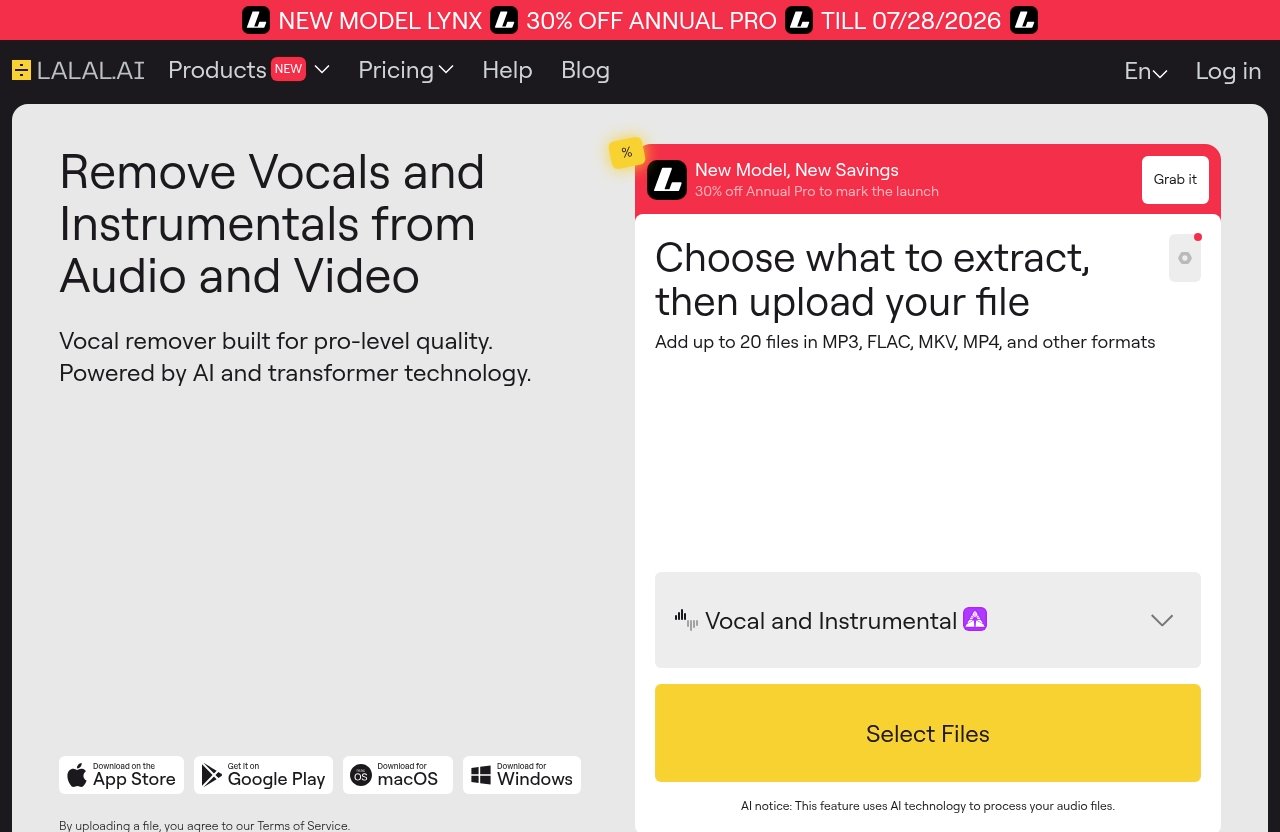
On its pricing page, LALAL.AI currently shows a promotion: “30% OFF ANNUAL PRO till 07/28/2026,” and it mentions a new model called LYNX. Since full pricing details can change or may not be fully visible in every context, it is best to check the current pricing page directly rather than rely on outdated numbers.
#2 Moises
Moises ranks second because it is one of the most approachable tools for musicians and creators. If your main goal is to split songs for practice, content creation, or simple arrangement work, it is a friendly option.
In many discussions around the best stem splitter 2026 landscape, Moises stands out for ease of use and consistently useful results. It does not feel like a technical utility first; it feels like a creator tool.
Strengths for creators and musicians
Moises is especially strong for musicians who want to learn parts, rehearse songs, or isolate elements without building a complicated production workflow. That matters because not every stem separation user is a mix engineer.
If you are a singer practicing with an instrumental, a guitarist learning a part, or a creator making a quick edit, Moises is easy to understand. That simplicity is a real strength.
It also belongs in any conversation about the best AI stem splitter for non-technical users, even if LALAL.AI is my preferred overall pick for precision and flexible production workflows.
When Moises is better than specialist tools
Moises may be better than specialist tools when speed and approachability matter more than deep control. If you do not want to think about models, spectral layers, repair brushes, or DAW routing, a guided creator-friendly experience is valuable.
It is also a better fit when the output does not need to survive heavy professional scrutiny. For practice, social content, quick covers, and rough remix ideas, convenience can matter more than microscopic editing.
The best stem splitter is not always the most advanced one. Sometimes it is the one you will actually use.
Trade-offs to consider
The main trade-off is that simpler tools can feel limiting if you want more control. Advanced users may eventually prefer UVR, SpectraLayers Pro, or a DAW-native workflow depending on the task.
As with every audio stem separation tool, results vary by source mix. Dense masters, overlapping midrange instruments, and heavy effects can create artifacts regardless of the platform.
Moises is easy to recommend for creators, but I would still compare it directly against LALAL.AI on your own material before committing to a workflow.
#3 Ultimate Vocal Remover (UVR)
Ultimate Vocal Remover, or UVR, is the best stem splitter option for users who want power, flexibility, and free/open-source appeal. It is not the most beginner-friendly pick, but it has earned a strong reputation among people who like to experiment.
If you have ever searched “best stem splitter reddit,” you have probably seen UVR mentioned by users who are comfortable with setup, model choices, and trial-and-error testing.
Why power users like it
Power users like UVR because it offers a more hands-on approach. Instead of hiding every decision, it gives technical users room to experiment with separation approaches and workflows.
That can be a major advantage if you know what you are listening for. You can test different settings, compare outputs, and choose the result that best suits the track.
For serious hobbyists, remixers, and audio tinkerers, UVR can be one of the most rewarding tools in the category.
Free/open-source appeal
UVR is the strongest answer if your search is specifically for stem separation software free. It is the best free option in this ranking because it can deliver genuinely useful results without requiring a commercial subscription.
That makes it ideal for students, experimental producers, and creators who are not ready to pay for a dedicated service. It also gives you a low-risk way to learn the strengths and weaknesses of AI separation.
Free, however, should not be confused with effortless. UVR rewards patience.
Learning curve and setup considerations
The downside is workflow friction. Compared with LALAL.AI or Moises, UVR usually requires more technical comfort.
You may need to spend time understanding options, managing files, and testing different outputs. That is fine if you enjoy control, but frustrating if you simply want a clean acapella in two minutes.
For this reason, UVR is not my best stem splitter recommendation for beginners. It is my recommendation for capable users who want a free, powerful tool and do not mind doing the work.
#4 Logic Pro Stem Splitter
Logic Pro Stem Splitter is the best DAW-native option for producers already working inside Apple’s music-production ecosystem. Its biggest strength is not that it replaces every dedicated separator; it is that it lives where Logic users already create.
If your production life happens inside Logic, a built-in stem workflow can be far more convenient than exporting audio, uploading it somewhere, downloading stems, and reimporting them.
Best for Apple ecosystem users
This pick is mainly for Apple and Logic Pro users. If you are already invested in that environment, DAW-native separation can make arranging and remixing feel more immediate.
You can split a track and start editing, chopping, warping, or arranging without switching tools. That is a meaningful workflow advantage.
For non-Logic users, though, this is less compelling. The best stem splitter for you should fit your actual setup, not force you into a new ecosystem.
Why DAW-native separation is convenient
DAW-native convenience matters because creative momentum is fragile. If you hear a vocal idea, drum loop, or bass edit, you want to test it quickly.
Logic Pro’s advantage is that the separation process can become part of the production session. That helps when you are writing, arranging, or sketching an edit.
It is also useful for producers who prefer not to rely on browser-based tools for every separation task.
Limitations versus dedicated web tools
The limitation is universality. A dedicated web or cross-platform tool like LALAL.AI is easier to recommend to a wider audience because it supports more operating systems and workflows.
Logic Pro Stem Splitter is best understood as a convenience feature for Logic users, not necessarily the best stem separation software for everyone. If you need mobile apps, Linux desktop support, a VST plugin workflow, or developer API access, you should compare other options.
It is excellent in context, but the context matters.
Official website · Latest pricing & offers
#5 Steinberg SpectraLayers Pro
Steinberg SpectraLayers Pro is the most specialized tool in this ranking. It is not just a stem splitter; it is a professional spectral editing environment used for detailed audio repair, restoration, and isolation work.
That makes it powerful, but also less casual. If you want one-click separation for remixes, it may be more tool than you need.
Where spectral editing excels
Spectral editing lets you see and manipulate sound visually across frequency and time. That can be extremely useful when you need to repair, isolate, or reduce specific elements in a recording.
For example, spectral workflows can help when a separated vocal still has unwanted fragments, or when you need to target a sound that a basic vocal remover tool cannot cleanly handle.
This is where SpectraLayers Pro earns its place: not as the easiest best stem splitter, but as a deep editing solution for people who know why they need it.
Best for repair and detailed isolation
SpectraLayers Pro is best for engineers, restoration specialists, post-production editors, and advanced producers who need more than automated separation. It is the kind of tool you use when the first pass is not enough.
If you are cleaning archival audio, doing forensic-style edits, or preparing difficult material for further mixing, deep spectral control can be valuable.
It can also complement other tools. You might use a faster separator first, then clean details in a spectral editor.
Who should skip it
Beginners should probably skip it unless they specifically want to learn spectral editing. It is not the most direct path to quick vocals, drums, or instrumentals.
If your goal is fast music stem separation for remixes, DJ edits, or practice tracks, LALAL.AI, Moises, or LANDR will usually feel more approachable.
SpectraLayers Pro is a pro pick for deep work, not a casual pick for quick splits.
#6 LANDR Stems
LANDR Stems is a good mainstream cloud-based option for creators who want accessible separation without a complicated setup. It fits the same broad market as many online music tools: convenient, approachable, and designed for creative speed.
It does not take my top spot, but it deserves a place among the best stem splitter tools for users who prefer a cloud workflow.
Good balance of convenience and results
LANDR’s appeal is convenience. For many creators, a cloud-based process is enough: upload, process, download, and move on.
That workflow is useful when you do not want to install a heavy application or configure technical settings. It also makes sense if stem splitting is only one part of your broader content workflow.
In a crowded best AI stem splitter market, accessibility still matters.
Use cases for creators
LANDR Stems can work well for social content, demos, practice materials, rough remix ideas, and quick edits. If you need stems occasionally rather than every day, a straightforward online tool may be all you need.
It is also useful for creators who already use online services and prefer not to manage local tools. Simplicity can save time.
Still, you should test it on your own music before deciding it is the best stem splitter for your needs.
Comparison versus dedicated leaders
Compared with LALAL.AI, LANDR Stems feels more like a convenient cloud option than a precision-and-workflow benchmark. Compared with UVR, it is less power-user oriented.
That is not a criticism; it is a positioning point. LANDR is best for people who value access and simplicity.
If you are building a serious stem-based production workflow, I would compare LANDR directly with LALAL.AI and Moises using the same source tracks.
#7 AudioStrip or Fadr
For the final slot, I am choosing Fadr as the lightweight web option. It represents the category of quick browser-based tools that can be useful when you need a fast separation without committing to a bigger workflow.
Fadr is not ranked seventh because lightweight tools are useless. It is ranked seventh because casual convenience usually comes with trade-offs in control, consistency, or professional workflow depth.
When a lightweight web tool is enough
A lightweight web tool is enough when the task is simple. Maybe you need a quick acapella preview, a rough instrumental, or a practice version of a song.
For these moments, you do not always need the best stem splitter overall. You need something fast and understandable.
This is especially true for casual creators who are testing ideas rather than preparing final production assets.
Fast turnaround for casual tasks
Speed is the main selling point. Browser-based tools are attractive because they reduce friction.
You can often test an idea quickly and decide whether the source track is even worth deeper work. That can be helpful before moving to a more precise tool.
For DJs, content creators, and hobbyists, that quick turnaround can be enough.
Why it lands lower in the ranking
Fadr lands lower because the best stem splitter should be reliable across more than casual jobs. For serious remixing, editing, or production, you may want stronger platform support, more stem options, DAW integration, or deeper cleanup tools.
That is why LALAL.AI, UVR, Logic Pro, and SpectraLayers sit higher. They cover more demanding workflows.
Fadr is a useful lightweight pick, but not my first recommendation for professional music stem separation.
How We Tested and Ranked the Best Stem Splitters
A good ranking needs more than “this sounded nice once.” Stem separation is highly source-dependent, so the right methodology should test tools across different arrangements and listen for specific failure points.
This is also why I avoid pretending there is one universal answer for every song. The best stem splitter for a dry pop vocal might not be the best tool for a dense rock master, a jazz recording, or a heavily compressed EDM track.
Separation quality
Separation quality is the first criterion. The question is simple: does the tool isolate the requested element clearly enough to use?
For vocals, that means the lead vocal should remain intelligible and centered, with minimal instrumental bleed. For drums, the kick, snare, cymbals, and room energy should remain coherent rather than smeared.
For bass, guitar, synths, strings, and winds, the challenge is often frequency overlap. Instruments that share the same range are harder to separate cleanly.
Artifact control
Artifacts are the strange leftovers you hear after processing. They can sound watery, metallic, phasey, robotic, or hollow.
A tool can technically isolate a vocal but still produce a result that is unpleasant in a remix. That is why artifact control matters as much as separation strength.
When comparing the best stem splitter options, I listen not only to the soloed stem but also to how it behaves in a new mix. Some artifacts are obvious alone but disappear under drums or effects.
Tone preservation
Tone preservation is about whether the extracted sound still feels like the original performance. A separated vocal should not lose all warmth, breath, or body.
This is especially important for producers and remixers. If you plan to pitch, time-stretch, compress, or reverb a stem, any damage from separation can become more obvious.
The best stem separation software should keep the useful character of the source intact as much as possible.
Speed and ease of use
Speed matters, but not only in processing time. It also includes how long it takes to understand the tool, choose the right setting, export stems, and bring them into your workflow.
This is where LALAL.AI and Moises perform well for many users. They reduce friction and make the process feel approachable.
UVR can be powerful, but the overall workflow may take longer if you are testing options. SpectraLayers Pro can go even deeper, but it is not designed mainly for instant casual splitting.
Format and stem options
The best stem splitter should support the type of separation you actually need. Some users only need vocals and instrumentals. Others need drums, bass, guitars, synths, or orchestral elements.
This is one reason the LALAL.AI stem splitter ranks high: its official Stem Splitter description covers vocals, instrumental, drums, bass, guitar, synth, string, and wind instruments.
Platform support also matters. A tool that works on desktop, mobile, DAW plugin workflows, or developer environments may fit more real-world use cases than a single-purpose web app.
How to Choose the Right Stem Splitter
Choosing the best stem splitter starts with your actual use case. Do not buy or learn the most advanced tool if you only need a quick vocal. Do not rely on a casual web tool if you need repeatable professional results.
The right choice depends on what you split most often, how clean the stems need to be, and where you want the tool to live in your workflow.
Best for vocals only
If you mostly need vocals, prioritize vocal clarity, artifact control, and ease of export. A strong vocal remover tool can be enough if your work is centered on acapellas and instrumentals.
LALAL.AI is my top recommendation here for most users because it combines clean vocal-focused separation with broader stem options. Moises is also a strong choice if you want a musician-friendly experience.
If your budget is zero and you are comfortable experimenting, UVR is the best free route.
Best for full tracks and remixes
For full tracks and remixes, you need more than vocal removal. You may want drums, bass, guitar, synth, strings, winds, and instrumentals depending on the arrangement.
This is where LALAL.AI becomes especially practical. It is not just about extracting vocals; it supports a wider set of musical elements.
For producers building remixes or sample-based edits, the best stem splitter should make it easy to audition multiple parts and quickly decide which ones are usable.
Best for beginners
Beginners should choose a tool that does not punish them with setup complexity. If you are new to audio stem separation, start with LALAL.AI or Moises.
Both are easier to approach than UVR or SpectraLayers Pro. You can focus on listening and learning what good separation sounds like instead of troubleshooting technical settings.
A beginner-friendly tool also helps you understand the limits of AI separation. You will quickly hear why some songs split beautifully while others resist clean isolation.
Best for professionals and engineers
Professionals should think in layers. Use a fast, high-quality separator for the first pass, then use DAW editing, restoration tools, or spectral repair when needed.
For many pro workflows, LALAL.AI is a strong first-pass tool because it is quick and flexible. Logic Pro Stem Splitter makes sense for producers already working inside Logic.
SpectraLayers Pro is the more specialized option for engineers who need detailed repair and manual isolation. UVR is excellent for technical users who want free control and are comfortable testing outputs.
Official website · Latest pricing & offers
FAQ
What is the best stem splitter for vocals?
LALAL.AI is my top pick for most people who want clean vocal isolation with a simple workflow. It balances precision, ease of use, and practical platform support well.
That said, vocal results vary by song. A dry, centered vocal in a sparse mix will usually separate more cleanly than a vocal buried under guitars, reverb, cymbals, and mastering compression.
Is there a free stem splitter that is actually good?
Yes. UVR is the strongest stem separation software free option in this roundup, especially for advanced users and budget-conscious producers.
The trade-off is usability. UVR usually requires more setup and technical comfort than paid tools like LALAL.AI or Moises, so it may not be the best first choice for beginners.
Do stem splitters work on every song?
No. Stem splitters do not work perfectly on every song.
Performance depends on the mix, arrangement, and how much overlap exists between vocals and instruments. Dense productions, heavy effects, distorted sources, and mastered tracks can all make music stem separation more difficult.
What’s the difference between a stem splitter and a vocal remover?
A vocal remover usually focuses on separating vocals from the instrumental. That is useful for acapellas, karaoke-style instrumentals, and simple edits.
A stem splitter can isolate multiple elements, such as drums, bass, guitar, synth, strings, winds, vocals, and instrumentals. If you are producing remixes or doing detailed audio work, a full stem splitter is usually more flexible.
Final Recommendation
The best stem splitter in 2026 depends on your workflow, but the overall winner is clear for most creators: choose the tool that gives clean enough stems quickly, does not overcomplicate the process, and supports the platforms you actually use.
No tool perfectly recreates original studio stems every time. The source mix still matters, and you should always audition results before building a final project around them.
Best overall pick
LALAL.AI is the best overall pick. It is the strongest balance of precision, ease, stem variety, and multi-platform workflow.
It is especially easy to recommend if you want vocals, instrumentals, drums, bass, guitar, synth, strings, and winds without jumping into a complex editor. If that sounds like your workflow, you can try LALAL.AI through this affiliate link and compare it on your own tracks.
Best budget pick
UVR is the best budget pick because it is the strongest free/open-source option for users who are willing to learn it. If you want stem separation software free and do not mind a more technical process, start there.
For beginners, though, free may cost you time. If speed and simplicity matter, a paid tool may be the better value.
Best pro pick
Steinberg SpectraLayers Pro is the best pro pick for deep editing, repair, and detailed isolation. It is not the easiest or fastest option, but it gives advanced users a level of control that one-click tools do not.
For most producers and creators, I would start with LALAL.AI, keep UVR in mind as the best free power-user option, and consider SpectraLayers Pro only when the job demands serious spectral editing.
Related Reading
- Lalal.AI Review for Producers in 2026
- How Much Does Lalal.AI Cost in 2026? Lalal.AI Pricing Guide
- Is Lalal.AI Free in 2026? What You Can Actually Do