
If you are comparing LALAL.AI vs stem splitters in 2026, the real question is not “which tool is newest?” It is “which stem separation workflow gives you clean enough results, fast enough, for the work you actually do?”
LALAL.AI remains a premium, verified-quality choice for users who want a polished stem isolation tool across web, desktop, mobile, plugin, and developer workflows. Newer AI stem splitter tools can still be attractive if you need offline processing, deeper editing, open-source flexibility, or a free entry point.
This LALAL.AI vs stem splitters comparison is written for producers, DJs, remixers, content editors, teachers, and musicians who want a practical buying decision—not hype.
Official website · Latest pricing & offers
LALAL.AI vs AI Stem Splitters in 2026: Quick Verdict
The short version: choose LALAL.AI if you want a convenient, commercially mature music stem splitter with broad separation options and multiple ways to work. Consider newer AI stem splitter tools if your priority is local-only processing, experimental control, or spending as little as possible.
This article compares LALAL.AI vs stem splitters as a category. That includes browser-based tools, local desktop apps, DAW plugins, mobile apps, open-source models, and newer AI music separation workflows.
Who should choose LALAL.AI
LALAL.AI is a strong fit if you want clean vocal removal, instrumental creation, and common stem extraction without building a technical workflow yourself. It is especially useful for people who split stems regularly for karaoke, remix prep, sampling ideas, practice tracks, podcast cleanup, and social content.
In my experience testing stem separation tools, the biggest practical difference is rarely one magic algorithm. It is the full workflow: upload or load the file, choose the target stem, preview the result, export something usable, and move on. That is where LALAL.AI vs stem splitters often becomes a convenience decision as much as an audio-quality decision.
If you want to evaluate it directly, you can try LALAL.AI through the official site and compare the results with one or two alternatives on your own source material.
Who should consider newer stem splitter tools
Newer stem splitter tools may be better if you need your audio to stay fully offline, want deeper editing inside a DAW, or like tweaking open-source models. Some users also prefer local tools because they can batch-process large libraries without uploading files, assuming their computer can handle the workload.
This is where lalal.ai alternatives deserve a fair look. A local AI stem splitter can be appealing for studio owners, sound designers, archivists, and anyone working with sensitive or unreleased material.
Free and open-source tools can also be good enough for hobby use. The trade-off is usually setup time, hardware dependence, less polished interfaces, or more manual troubleshooting.
Short answer by use case: producers, DJs, remixers, editors
| Use case | Best fit | Why |
|---|---|---|
| Karaoke backing tracks | LALAL.AI | Simple vocal remover and instrumental workflow |
| Remix prep | LALAL.AI or DAW-integrated splitter | Depends whether you need quick stems or deeper editing |
| DJ edits | Browser or desktop splitter | Speed and convenience matter most |
| Sampling | LALAL.AI or local tools | Depends on privacy, source quality, and cleanup needs |
| Podcast cleanup | LALAL.AI Voice Cleaner | Useful when music, rumble, plosives, or noise need reduction |
| Music education | LALAL.AI or mobile splitter | Easy access matters for students and teachers |
| Experimental sound design | Local/open-source tools | More control and repeatable offline processing |
For most non-technical users, the LALAL.AI vs stem splitters verdict is simple: LALAL.AI is the safer premium choice when you want a polished separation workflow, while newer tools are worth testing if you have a specific technical need.
What LALAL.AI Actually Offers in 2026
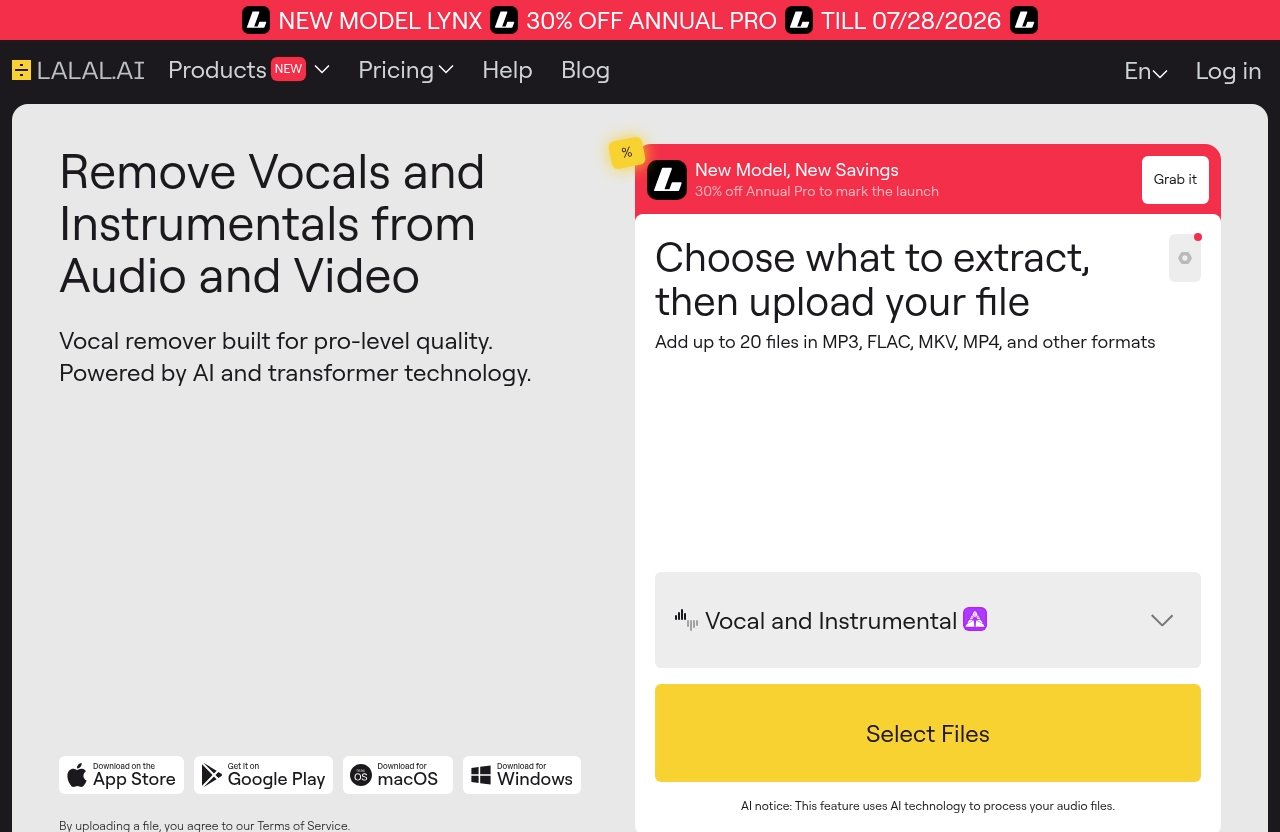
Before comparing LALAL.AI vs stem splitters, it helps to separate verified product facts from opinion. The following feature summary is based on LALAL.AI’s official homepage information.
Official product overview
LALAL.AI is positioned as an AI audio and video processing platform, not only a basic vocal remover. Its official product line includes tools for separating stems, cleaning voice recordings, changing voices, cloning voices, and removing echo or reverb.
That matters because many stem separation tools do only one job: split a song into parts. LALAL.AI covers several adjacent tasks that often happen in real projects. For example, a creator might extract vocals, remove background noise from a spoken section, and prepare a clean instrumental for a short-form video.
In a practical LALAL.AI review, the broad product coverage is one of the main value points. You are not only buying access to a single vocal remover; you are buying into a larger AI music separation and audio cleanup workflow.
Supported stem types and product line
According to the official LALAL.AI homepage, the product line includes:
| Official LALAL.AI tool | Verified purpose |
|---|---|
| Vocal Remover | Remove vocals and instrumentals from any music track, audio clip, or video |
| Stem Splitter | Extract vocals, instrumental, drums, bass, guitar, synth, string, and wind instruments |
| Voice Cleaner | Remove background music, vocal plosives, mic rumble, and other unwanted noises |
| Voice Changer | Transform and change your voice in music, audio recordings, and video files |
| Voice Cloner | Build a personalized AI voice model from your own recordings and audio samples |
| Echo & Reverb Remover | Remove echo and reverb from vocals, voice recordings, songs, and videos |
| Lead/Back Splitter | Separate lead and backing vocals |
The important distinction in vocal remover vs stem splitter comparisons is that a vocal remover usually creates two outputs: vocal and instrumental. A stem splitter is broader. It can target instruments such as drums, bass, guitar, synth, strings, and winds depending on the product.
That broader stem support is one reason LALAL.AI vs stem splitters is not a simple one-feature comparison. LALAL.AI competes with both quick vocal-removal apps and fuller music stem splitter platforms.
Apps and integrations available
LALAL.AI’s official homepage lists the following apps and integrations:
| Platform or integration | Officially listed availability |
|---|---|
| Desktop | Windows, macOS, and Linux |
| Mobile | iOS for iPhone and iPad |
| Mobile | Android for phones and tablets |
| Plugin | VST Plugin that runs locally inside your DAW |
| Developer access | API for developers |
This is a major point in the LALAL.AI vs stem splitters decision. Some tools are web-only. Others are desktop-only. Some are DAW-native but not convenient on mobile. LALAL.AI’s listed platform coverage gives users more ways to fit stem separation into their existing process.
For related workflow guides, you may also want to see SplitTheTrack’s internal resources on [the best stem splitter 2026](/best-stem-splitter-2026/) and [how to remove vocals from a song](/remove-vocals-from-song/).
How Modern AI Stem Splitters Differ From Each Other
The AI music separation market has become more diverse. When people search for LALAL.AI vs stem splitters, they are often comparing several tool categories at once without realizing it.
A fair ai stem splitter comparison should look at workflow, device support, privacy, audio quality, editing depth, export options, and cost—not only the marketing phrase “AI-powered.”
Cloud upload tools vs local desktop tools
Cloud upload tools usually let you process audio through a browser or connected app. The benefit is convenience: you do not need to manage model files, GPU drivers, command-line tools, or local processing limits.
Local desktop tools run on your machine. They may be better for offline workflows, sensitive sessions, large batches, or users who prefer not to upload audio. The trade-off is that performance depends on your computer, and setup can be more technical.
In real-world LALAL.AI vs stem splitters testing, cloud tools often feel easier for one-off jobs. Local tools can feel better when you are building a repeatable studio process and want tighter control.
Consumer apps vs DAW plugins
Consumer apps are built for fast outcomes. You select a track, choose stems, and export. They are ideal for karaoke, social content, rehearsal tracks, quick DJ edits, and casual remix exploration.
DAW plugins are different. They live inside a production environment such as a digital audio workstation, where you can combine stem separation with editing, EQ, comping, time-stretching, arrangement, and mixing.
LALAL.AI is notable because the official homepage lists a VST Plugin that runs locally inside your DAW. That helps bridge the gap between consumer convenience and production workflow, although users who need deep note-level repair may still prefer specialized DAW-native editing systems.
Simple separation vs stem editing and reconstruction
A simple stem separation tool answers the question: “Can I isolate this vocal, drum part, bassline, or instrumental?” A deeper stem editing tool asks: “Can I manipulate the separated material in detail after extraction?”
That difference matters. If you only need an acapella for a remix sketch, simple separation may be enough. If you need to repair notes, rebalance individual phrases, reconstruct an arrangement, or perform detailed spectral editing, you may need a more advanced workflow.
This is why LALAL.AI vs stem splitters should not be judged by stem count alone. Stem count tells you what the tool can target. Editing depth tells you what you can do after the split.
Where LALAL.AI Wins
LALAL.AI’s strength is not that every user should ignore every alternative. Its strength is that it packages several high-demand audio separation and cleanup tasks into an accessible commercial product.
For buyers comparing LALAL.AI vs stem splitters, the most persuasive advantages are clean common-use workflows, broad stem support, and cross-platform convenience.
Clean vocal isolation and instrumental removal
Vocal isolation is still the most common reason people use stem separation tools. Producers want acapellas. Singers want backing tracks. Teachers want practice versions. Editors want to remove music or isolate speech.
LALAL.AI’s official Vocal Remover is designed to remove vocals and instrumentals from music tracks, audio clips, or video. Its Lead/Back Splitter also targets separation between lead and backing vocals, which can be useful when a standard vocal split is not specific enough.
No AI stem splitter can guarantee perfect results on every track. Dense mixes, heavy reverb, layered harmonies, distortion, and mastering compression can all create artifacts. But for many common vocal and instrumental tasks, LALAL.AI gives buyers a straightforward way to get usable results without building a technical chain.
Broad stem support for common music-production tasks
The official LALAL.AI Stem Splitter supports vocals, instrumental, drums, bass, guitar, synth, string, and wind instruments. That makes it more flexible than tools focused only on vocal removal.
In practice, this matters for producers and remixers. Isolating drums can help with groove analysis. Pulling bass can support transcription or practice. Extracting guitar, synth, strings, or winds can help with sampling, arrangement study, and creative remix prep.
This is where LALAL.AI vs stem splitters becomes commercially relevant. If you need multiple stem targets and do not want separate tools for each job, LALAL.AI’s product coverage is a meaningful advantage.
Convenience across web, desktop, mobile, and plugin workflows
Convenience is underrated until you are working under a deadline. If you are preparing a DJ edit before a set, cleaning a voice clip for a video, or generating a rehearsal track during a lesson, workflow friction matters.
LALAL.AI’s official platform list includes desktop apps for Windows, macOS, and Linux; iOS and Android apps; a VST Plugin; and an API. That gives different users different paths into the same broader platform.
In the LALAL.AI vs stem splitters buying decision, this cross-platform coverage can outweigh small differences in isolated tests. The best tool is often the one you can reliably use wherever the project starts.
Where Newer Stem Splitter Tools May Beat LALAL.AI
A fair comparison should also explain where newer stem separation tools can be stronger. LALAL.AI is a strong premium option, but it is not automatically the best fit for every producer or engineer.
The biggest category-level advantages among newer tools are offline processing, deeper editing, and free or lower-cost experimentation.
Local processing and offline workflows
Some users need a stem splitter that never depends on a cloud upload. That can be important for unreleased songs, client sessions, archival work, legal review, or environments with poor internet access.
Local processing can also be useful for batch workflows. If you have a powerful computer and a large library, an offline desktop setup may be more comfortable than repeatedly sending files through a browser-based process.
When comparing LALAL.AI vs stem splitters, ask where your audio is allowed to go. If your policy requires everything to stay on one workstation, a local-first tool may be the right answer.
Deeper stem editing and note-level control
Some newer tools are not just separators. They are editors that let you work inside the separated material. Depending on the software category, this may include spectral repair, detailed timing work, note-level manipulation, or reconstruction-style workflows.
That extra control is valuable for advanced production. A remix producer may want to reshape a vocal phrase. A restoration engineer may need to reduce bleed around specific syllables. A composer may want to study or rebuild a part rather than simply export it.
LALAL.AI covers broad separation and related audio tools, but if your priority is surgical post-separation editing, compare it carefully against DAW-native or specialist editing systems.
Free or lower-cost entry points
Free tools can be good enough, especially for hobbyists, students, and technical users who enjoy experimentation. Open-source projects such as source separation models have helped make AI music separation more accessible, though setup and results vary by tool and track.
The trade-off is time. Free stem separation tools may require installation work, GPU configuration, manual model selection, or less polished export handling. For some users, that is acceptable. For others, paying for a smoother interface is the better value.
This is one of the most honest conclusions in any LALAL.AI vs stem splitters comparison: free is attractive, but free is not always cheaper if it costs you hours of troubleshooting.
Official website · Latest pricing & offers
Best Use Cases by Job-to-be-Done
Brand comparisons are useful, but jobs-to-be-done are better. The best stem separation tools are the ones that solve your specific audio problem with the least compromise.
Here is how I would think about LALAL.AI vs stem splitters by real project type.
Karaoke and instrumental creation
For karaoke, you usually want the vocal removed while keeping the instrumental as natural as possible. The biggest problems to listen for are watery high frequencies, vocal ghosts, missing snare brightness, and reverb tails that still reveal the original singer.
LALAL.AI’s Vocal Remover is built for removing vocals and instrumentals from music tracks, audio clips, or video. That makes it a logical premium option for karaoke creators, singers, teachers, and casual users who want quick backing tracks.
If you are producing commercial karaoke releases, you should test every track carefully and check rights requirements. AI separation does not automatically create a legally cleared backing track.
Sampling and remix prep
For sampling, the goal is not always perfect separation. Sometimes a slightly imperfect stem works if it has the right texture, groove, or emotional character. A bass stem with minor bleed may still be useful after filtering, chopping, or layering.
For remix prep, vocals are usually more demanding. Lead vocals exposed over a new instrumental reveal artifacts quickly, especially in breaths, sibilance, and reverb tails. This is where careful listening matters more than a waveform screenshot.
In LALAL.AI vs stem splitters testing for remix work, I recommend trying the same chorus, verse, and breakdown in multiple tools. Some models handle dense choruses well, while others perform better on sparse sections.
Podcast and voice cleanup
Not every stem separation task is music production. Voice cleanup is increasingly important for podcasters, YouTubers, course creators, and editors working with imperfect recordings.
LALAL.AI’s official Voice Cleaner removes background music, vocal plosives, mic rumble, and other unwanted noises. Its Echo & Reverb Remover targets echo and reverb from vocals, voice recordings, songs, and videos.
If your main job is spoken-word cleanup, compare LALAL.AI against dedicated dialogue repair tools as well as music stem splitter apps. The right choice depends on whether your problem is background music, room sound, plosives, rumble, or general noise.
Practice tracks and music education
Stem separation is extremely useful for learning. Bassists can isolate basslines. Drummers can study grooves. Guitarists can reduce other parts to focus on rhythm and tone. Vocalists can create instrumental versions for rehearsal.
For teachers, the best tool is often the easiest one to explain. Mobile and web access can matter more than advanced controls, especially in lessons or classroom settings.
This is another area where LALAL.AI vs stem splitters favors practical convenience. If students can use the tool on phones, tablets, desktops, or a studio computer, adoption is easier.
LALAL.AI Pricing and Value
Pricing is a major part of any commercial investigation. However, pricing pages can change, and the source excerpt available for this article does not include confirmed current plan names, prices, or included extras.
For that reason, this section avoids guessing. Before you buy, check the live official pricing page or check LALAL.AI pricing through the official site.
Verified pricing information from the official pricing page
PRODUCT FACTS: LALAL.AI Pricing
The available official pricing-page excerpt for this article does not include verified plan names, prices, minute limits, credit structures, renewal terms, or extras. Therefore:
- Do not rely on outdated third-party pricing summaries.
- Do not assume older plan names or prices are still current in 2026.
- Verify pricing directly on LALAL.AI’s live official pricing page before purchasing.
- Compare the current plan structure against your expected usage volume.
This is especially important in a LALAL.AI pricing comparison because audio tools often change plan limits, file-size rules, subscription terms, or one-time package options.
What the plan structure means for heavy vs occasional users
Occasional users should focus on the cost of solving a few specific jobs. If you only need to remove vocals from several tracks for practice, you may not need the same plan as a remix producer processing stems every week.
Heavy users should evaluate total workflow cost. That includes upload time, preview limits, export handling, number of stems needed, and whether the platform supports the devices and apps they use daily.
In a practical LALAL.AI vs stem splitters value comparison, the cheapest tool is not always the best deal. A free tool that takes hours to configure may be poor value for a working editor, while a paid platform may be excessive for someone splitting one song per month.
When the paid model makes sense
A paid model makes sense when clean output, convenience, and repeatability matter. If you use stem separation for client work, content production, teaching, remixing, or regular practice materials, saving time can justify paying.
It also makes sense when you need more than one audio utility. LALAL.AI’s official product line includes stem splitting, vocal removal, voice cleaning, voice changing, voice cloning, echo and reverb removal, and lead/back vocal separation.
The paid model is less compelling if you enjoy open-source tools, have a powerful local machine, and only need occasional experimental separations.
How to Compare Stem Splitters Before You Buy
A good buyer checklist prevents disappointment. Do not choose a tool based only on a polished demo track. Test it on the messy, dense, real-world audio you actually use.
Use this checklist when comparing LALAL.AI vs stem splitters or any other stem separation tools.
Audio quality and artifact level
Artifacts are unwanted sounds created by the separation process. Common artifacts include watery or phasey textures, chirping, muffled transients, metallic ringing, missing consonants, and unstable reverb tails.
Bleed means audio from one source remains in another stem. For example, you may hear faint vocals in an instrumental, cymbals in a vocal stem, or bass energy in a drum stem.
A good split is not always artifact-free. It is good if the artifacts are low enough for your intended use. A practice track can tolerate more artifacts than a commercial remix vocal.
Stem count and separation targets
Check which stems the tool actually supports. Some products split only vocals and instrumental. Others target drums, bass, guitar, synth, strings, winds, or lead and backing vocals.
LALAL.AI’s official Stem Splitter supports vocals, instrumental, drums, bass, guitar, synth, string, and wind instruments. Its Lead/Back Splitter also targets lead and backing vocal separation.
When doing a LALAL.AI vs stem splitters comparison, do not assume more stems automatically means better results. A tool with fewer targets may still perform well for one specific job.
Workflow speed, privacy, and device support
Workflow speed is not only processing time. It includes how quickly you can start, preview, adjust, export, rename, organize, and bring files into your DAW or editor.
Privacy also matters. Cloud tools involve uploading files. Local tools may keep processing on your machine. DAW plugins may fit better into professional sessions where file management is strict.
Device support can be decisive. LALAL.AI’s official homepage lists desktop apps for Windows, macOS, and Linux; iOS; Android; a VST Plugin; and an API. If you work across devices, that coverage is valuable.
Export formats and editing controls
Before buying any stem isolation tool, check the available export formats and how they fit your workflow. Producers may need high-quality audio files for DAW use. Video editors may care about compatibility with editing software. Developers may care about API output behavior.
Also check whether the tool allows previews, batch handling, stem selection, or post-processing controls. Some simple tools are fast but rigid. Some advanced tools are powerful but slower to learn.
For more buying guidance, see SplitTheTrack’s guide to [AI vocal remover tools](/ai-vocal-remover/) and [stem separation for remixing](/stem-separation-for-remixing/).
Testing Method: How We Judge Stem Splitters Fairly
To compare LALAL.AI vs stem splitters fairly, you need a repeatable test method. Randomly trying one polished pop song is not enough.
A fair test uses multiple genres, difficulty levels, and intended outcomes. The winner for karaoke may not be the winner for podcast cleanup or bass transcription.
Track selection and difficulty levels
Use at least five types of source material:
| Test track type | Why it matters |
|---|---|
| Sparse acoustic song | Reveals vocal tone and natural reverb handling |
| Dense pop chorus | Tests layered vocals, synths, and mastering compression |
| Rock or metal mix | Tests guitars, cymbals, distortion, and bleed |
| Hip-hop or electronic track | Tests bass, drums, samples, and sub energy |
| Spoken-word clip with noise | Tests cleanup beyond music separation |
I like to test a verse, chorus, and breakdown separately when possible. AI music separation can behave differently depending on arrangement density.
In LALAL.AI vs stem splitters testing, always use the same source files, same sections, and same listening chain. Otherwise, your comparison becomes guesswork.
What counts as a good stem split
A good stem split is fit for purpose. A vocal stem for remixing should preserve intelligibility, timing, breath detail, and emotional tone. An instrumental for karaoke should reduce the lead vocal without destroying the groove.
For drums, listen to kick impact, snare crack, hi-hat stability, and cymbal shimmer. For bass, listen for note definition and low-end continuity. For guitar and synth, listen for chord clarity and modulation artifacts.
Do not judge only in solo. A stem that sounds imperfect alone may work beautifully in a new mix. Conversely, a stem that sounds impressive solo may create problems once compressed, EQ’d, or layered.
What to listen for in artifacts and bleed
Listen on headphones first, then speakers. Headphones reveal small artifacts, while speakers show whether the stem still works musically.
Pay attention to:
- Vocal ghosts in instrumentals
- Cymbal wash leaking into vocal stems
- Warbling around sustained notes
- Missing consonants or dull transients
- Pumping or unstable reverb tails
- Bass notes disappearing or smearing
- Stereo image collapse
When comparing LALAL.AI vs stem splitters, keep notes by use case. A tool may win for vocal isolation but lose for drum extraction. Another may be excellent offline but inconvenient for quick mobile work.
Final Recommendation: Is LALAL.AI Still Worth It in 2026?
For most buyers, LALAL.AI is still worth serious consideration in 2026. It combines broad official stem support, vocal and instrumental removal, voice cleanup tools, lead/back vocal separation, mobile access, desktop apps, a VST Plugin, and an API.
The most balanced LALAL.AI vs stem splitters recommendation is this: choose LALAL.AI when you want a premium, polished, multi-purpose workflow; choose a newer tool when you have a specific reason to prioritize offline control, deeper editing, or free experimentation.
Best fit for most users
LALAL.AI is best for users who want to get from source track to usable stem quickly. That includes singers, DJs, remixers, music teachers, content creators, sample hunters, and editors who do not want to manage technical setup.
It is also a good fit if your needs go beyond music splitting. Voice Cleaner, Echo & Reverb Remover, Voice Changer, Voice Cloner, and Lead/Back Splitter make the platform broader than a basic music stem splitter.
In a buyer-focused LALAL.AI vs stem splitters comparison, that breadth matters. You may start with vocal removal and later need podcast cleanup, backing vocal separation, or DAW plugin access.
When to choose a newer stem splitter instead
Choose a newer stem splitter instead if you require local-only processing, want maximum control inside a specialist editor, or prefer open-source workflows. Also consider alternatives if you are comfortable troubleshooting and want the lowest possible cost.
Some advanced producers may prefer tools that integrate deeply into their DAW editing process. Some technical users may prefer running open models locally. Some casual users may be satisfied with a free browser tool for occasional practice tracks.
That does not make LALAL.AI weaker. It means the best stem splitter 2026 choice depends on your job, privacy needs, budget, and tolerance for setup.
Bottom-line recommendation
If you want a clean, convenient, commercially mature stem separation platform, LALAL.AI is an easy tool to recommend testing first. It is especially compelling for vocal removal, instrumental creation, common production stems, voice cleanup, and cross-device workflows.
If you are comparing lalal.ai vs stem splitters before buying, run your own test on two or three real tracks. If LALAL.AI gives you usable stems faster than the alternatives, its paid model can make practical sense. If a local or free tool gives you equal results for your exact workflow, use that instead.
The bottom line: LALAL.AI remains a premium, verified-quality choice in 2026, while newer stem splitters are best viewed as specialized alternatives rather than automatic replacements.
Official website · Latest pricing & offers
FAQ
Is LALAL.AI better than other stem splitters in 2026?
LALAL.AI is often a better choice for users who want clean, convenient separation for common music and voice tasks. Its official product line covers vocal removal, stem splitting, voice cleaning, echo and reverb removal, and lead/back vocal separation.
However, no tool is best for every workflow. Newer stem splitters may beat LALAL.AI for fully offline processing, deeper editing, open-source customization, or free use.
What is the best AI stem splitter for vocals?
The best AI stem splitter for vocals depends on the source track and intended use. Dense mixes, backing vocals, reverb, distortion, and mastering compression can all affect vocal extraction quality.
LALAL.AI is a strong premium choice for clean vocal extraction and instrumental removal, especially if you want an easy workflow. For critical remix work, test the same vocal section across multiple tools before committing.
Are there free stem splitters that are good enough?
Yes, some free or open-source stem splitters are good enough for certain tracks and users. They can be especially useful for students, hobbyists, and technical producers who do not mind extra setup.
The trade-off is usually convenience. Free tools may require more configuration, local hardware resources, manual exporting, or troubleshooting.
Does LALAL.AI work on mobile or inside a DAW?
Yes. The official LALAL.AI homepage lists iOS apps for iPhone and iPad, Android apps for phones and tablets, desktop apps for Windows, macOS, and Linux, a VST Plugin that runs locally inside your DAW, and an API for developers.
That broad device support is one of the stronger practical points in the LALAL.AI vs stem splitters comparison.
Is LALAL.AI worth paying for instead of using free tools?
LALAL.AI is worth paying for if you split stems regularly, care about convenient output, and value a polished workflow over technical setup. It is especially sensible for creators, teachers, editors, and producers who use stem separation as part of ongoing work.
Free tools are still worth trying if your budget is tight or you enjoy open-source experimentation. The right choice depends on how often you split stems, how clean the results need to be, and how much your time is worth.
Related Reading
- Lalal.AI Pricing Plans Explained in 2026
- Best Stem Splitter 2026: Top 7 Tools for Clean Vocals, Drums, Bass, and Remix Stems
- Lalal.AI vs Splitter AI: Which Stem Separator Is Better in 2026?