
Official website · Latest pricing & offers
LALAL.AI Source Separation in 2026: Quick Verdict
My short take: lalal.ai source separation is a better fit for users who need more than a one-click instrumental track. LALAL.AI offers both a Vocal Remover for straightforward karaoke-style jobs and a Stem Splitter for people who want more control over drums, bass, guitar, synths, vocals, and other musical elements.
Affiliate disclosure: Splitthetrack.com may earn a commission if you purchase through a partner link, at no additional cost to you. If you want to review the current product options directly, you can visit the official LALAL.AI website.
The key buying question is not simply, “Can it remove vocals?” Most tools in this category attempt that. The more useful question is whether you need isolated musical parts for remixing, sampling, DAW editing, practice tracks, or content production. That is where a broader AI stem separation workflow becomes more valuable than a basic vocal remover.
Who this tool is best for
LALAL.AI makes the most sense for musicians, producers, DJs, video editors, teachers, and serious hobbyists who regularly work with existing songs. If your work involves extracting a drum part for reference, isolating bass for transcription, or separating lead vocals from backing vocals, the wider toolset has practical appeal.
In this lalal.ai review 2026, I would position the platform as a flexible separation suite rather than a single-purpose karaoke utility. Users who need several kinds of output from the same song are likely to get more value from that flexibility.
When a simple vocal remover is enough
A simple vocal remover can be enough when your goal is limited to making a rough karaoke backing track or hearing a song with reduced lead vocal presence. For a birthday party, a casual singalong, or personal practice, you may not need separate bass, drums, guitar, and synth files.
In those situations, paying extra attention to advanced lalal.ai source separation options may be unnecessary. The simpler path is usually more appropriate when you only need one vocal-versus-instrumental result and do not intend to edit the output further.
When multi-stem separation matters more
Multi-stem separation becomes valuable when the individual parts matter as much as the finished instrumental. A producer may want drums without bass, a guitarist may want to study a rhythm part, and an editor may need a vocal isolated from other elements.
That is the practical difference between a basic remover and the LALAL.AI Stem Splitter. Rather than treating a full instrumental as one block, a multi-stem workflow can offer more targeted material for creative or technical use.
What LALAL.AI Actually Does
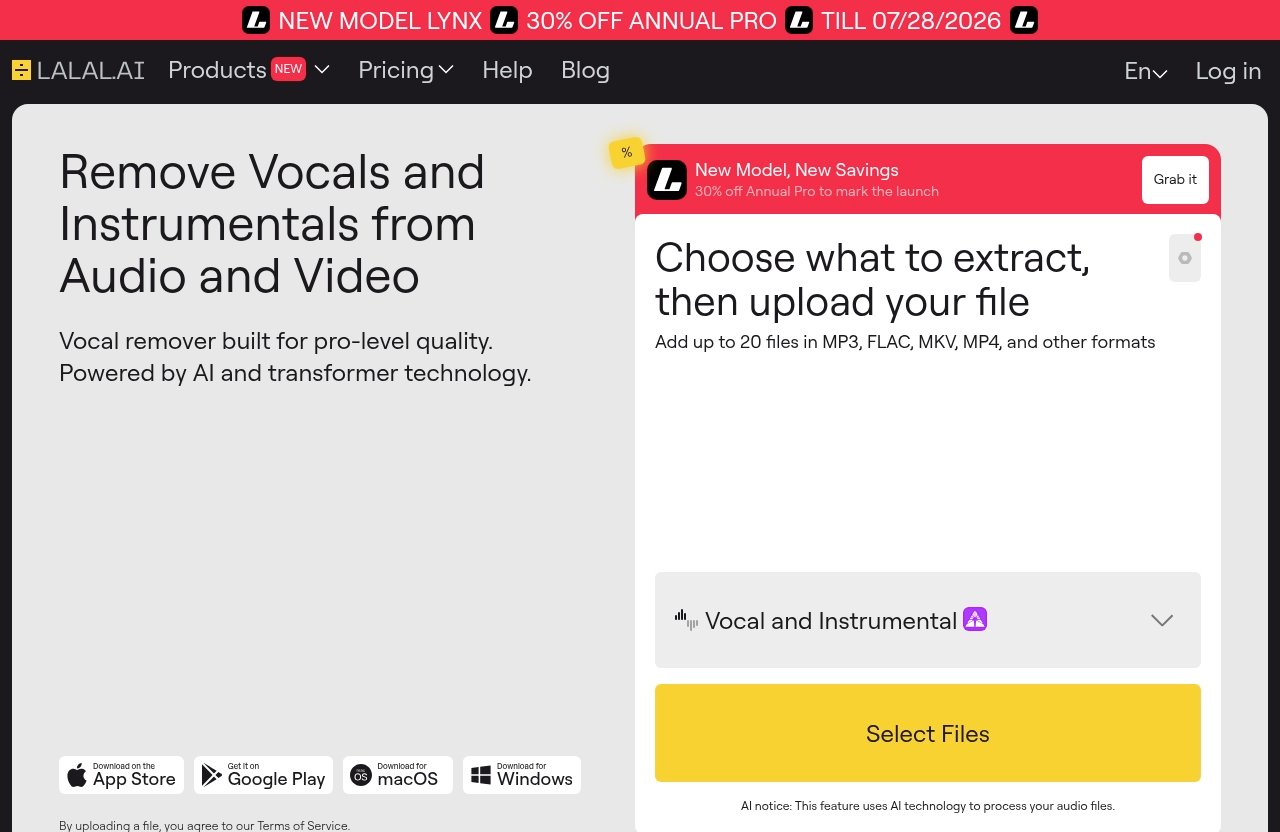
LALAL.AI is an audio-processing product suite with several tools listed on its official homepage: Vocal Remover, Stem Splitter, Voice Cleaner, Voice Changer, Voice Cloner, Echo & Reverb Remover, and Lead/Back Splitter. For buyers focused on music, the most relevant products are generally the Vocal Remover, Stem Splitter, and Lead/Back Splitter.
The distinction matters because lalal.ai source separation is not limited to removing a singer from a song. Its broader purpose is to help users divide a mixed audio file into more useful component parts.
Vocal remover vs stem splitter
The LALAL.AI Vocal Remover addresses the familiar use case: separating vocals from an instrumental. This is the natural starting point for karaoke tracks, vocal practice, rough acapella creation, and quick content edits.
The lalal.ai stem splitter is aimed at a wider music source separation task. According to LALAL.AI’s official product information, it can extract vocals, instrumental, drums, bass, guitar, synth, string, and wind instruments. That makes it more relevant when an instrumental track alone is too broad for the job.
A useful way to think about the difference is this:
| Need | More Suitable LALAL.AI Tool |
|---|---|
| Karaoke-style backing track | Vocal Remover |
| Basic acapella for a quick edit | Vocal Remover |
| Separate drums and bass for a remix sketch | Stem Splitter |
| Instrument-focused practice material | Stem Splitter |
| Distinguish lead singing from harmonies | Lead/Back Splitter |
| Reduce echo or reverb in voice audio | Echo & Reverb Remover |
Lead/Back Splitter
The LALAL.AI Lead/Back Splitter is especially relevant for vocal-heavy projects. Its official claim is that it separates lead and backing vocals with pinpoint accuracy, which is useful in principle for arrangements where harmonies, doubles, and background parts need separate attention.
For remixers and vocal editors, that is a more specialized task than ordinary lalal.ai source separation. A conventional vocal remover may give you one vocal stem, but it does not necessarily address the creative difference between the main vocal performance and supporting voices.
As with any separation process, source material still matters. Dense harmonies, effects-heavy mixes, and vocals sharing the same frequency range can make any extraction task more demanding, so it is sensible to treat results as editable source material rather than guaranteed final masters.
Voice Cleaner, Voice Changer, Voice Cloner, and Echo & Reverb Remover
The rest of the suite expands LALAL.AI beyond song splitting. Voice Cleaner, Voice Changer, Voice Cloner, and Echo & Reverb Remover are listed as official tools, each serving a different voice-processing need.
For a producer deciding whether to buy into a wider ecosystem, these tools may add convenience. However, the central reason to choose lalal.ai source separation remains the ability to work with music elements, not the mere presence of extra voice utilities.
How Good Is LALAL.AI for Multi-Stem Source Separation?
The honest answer is that stem separation quality should be judged against the particular track, not marketing language alone. AI separation works by estimating what belongs to a vocal, drum, bass, or instrument category inside a completed mix. It is not the same as receiving the original studio multitrack session.
For that reason, the best approach is practical and skeptical: use LALAL.AI when separated material can save time or create a usable starting point, but do not assume every output will be pristine enough for release without further editing. This is true of lalal.ai source separation and the wider AI music-separation category.
Stems supported by the official Stem Splitter
The official Stem Splitter claim covers the following outputs:
| Officially Listed Stem Types | Typical Reason to Separate Them |
|---|---|
| Vocals | Acapellas, vocal editing, remix references |
| Instrumental | Karaoke, backing tracks, music beds |
| Drums | Beat study, remix construction, practice |
| Bass | Transcription, arrangement analysis |
| Guitar | Guitar practice and sample preparation |
| Synth | Electronic arrangement analysis |
| String instruments | Orchestral or pop arrangement study |
| Wind instruments | Brass and wind-focused isolation |
This list is one reason the lalal.ai stem splitter deserves more consideration from producers than a simple vocal-only tool. It supports decisions that happen after separation: cutting a sample, muting a part in a practice track, checking an arrangement, or building a remix session.
It is worth noting that the official stem list does not explicitly name piano. While a piano part may be present within a broader instrumental mix, buyers should not assume a dedicated piano stem unless that capability is clearly confirmed on the official product page.
Where stem separation is strongest in practice
In practical workflows, separated stems are most useful when the goal tolerates some cleanup or when the extracted part is used as a creative reference. For example, a producer can use separated drums to understand groove placement, then program an original drum part in a DAW. A guitarist can mute vocals and focus on rhythm patterns without needing a studio-perfect guitar stem.
Lalal.ai source separation can also help video creators who need to lower a vocal, retain a music bed, or create a more suitable background layer for an edit. The real benefit is speed: instead of abandoning a track because the mix is “locked,” you have a route to workable components.
For sampling, the output may be useful as a starting point, particularly when you plan to chop, process, layer, or transform it. If the sample will be exposed and unprocessed, listen critically for bleed, artifacts, or missing transients before relying on it.
Trade-offs to watch for in dense mixes
The hardest material for any music source separation system is typically a dense mix with overlapping instruments, heavy effects, wide stereo processing, distortion, crowd noise, or stacked vocals. Similar frequencies can overlap, and reverb can smear the boundaries between parts.
That does not make the tool ineffective; it means expectations should match the source. A clean vocal over a sparse arrangement is a different challenge from a heavily compressed, effects-driven pop master or a live recording with audience ambience.
If you are looking for the best stem separator for professional work, judge it with your own representative material. Upload or process a range of tracks where permitted, including the difficult material you actually need to use, then decide whether the separation is clean enough for your workflow.
Vocal Remover Use Cases: Karaoke, Acapellas, and Backing Tracks
The lalal.ai vocal remover is the sensible option when the desired result is uncomplicated: reduce or remove the vocal to make an instrumental-style backing track, or isolate the vocal for an acapella-based edit. Many people do not need a full set of stems to get useful results.
For casual buyers, that distinction can prevent overspending. The broader source-separation suite is valuable, but only if you will use the additional control it provides.
Best scenarios for the vocal remover
Karaoke is the clearest use case. If you want a song where the lead vocal is removed or reduced so someone can sing over the music, a vocal-removal workflow is directly aligned with that outcome.
Acapella creation is another common reason to use the tool. An extracted vocal can be useful for studying phrasing, making a rough mashup, preparing a social edit, or testing how a vocal might work over an original production. Be realistic, however: an acapella made from a finished mix may retain traces of instrumentation or effects depending on the original recording.
How it compares to full stem workflows
A vocal remover divides the track into a simple vocal-versus-instrumental relationship. Full lalal.ai source separation is more granular because it can address several distinct musical categories rather than treating the entire backing track as one undifferentiated file.
For example, a karaoke user may be happy with an instrumental output. A remixer may need to keep drums but remove bass, or isolate guitar while avoiding the rest of the band. The latter workflow requires more stem-level control.
Why casual users may not need every stem
More stems are not automatically better. Each additional separated file creates more choices, more listening, and potentially more cleanup. If you are not going to edit the parts separately, a simple vocal remover keeps the process focused.
Choose the basic path when the destination is a single backing track or a quick vocal extraction. Consider the more advanced lalal.ai source separation route when you know you will benefit from controlling musical layers independently.
Why Producers Care About Stems Instead of Just Vocals
Producers care about stems because a completed mix is restrictive. Once drums, bass, vocals, guitars, and synths are combined into one stereo file, editing one element without changing the others becomes difficult. Stem extraction creates room for experimentation even when the original project files are unavailable.
That does not replace proper multitracks from a recording session. But AI stem separation can be a practical bridge between a finished reference track and a flexible creative workspace.
Drums, bass, guitar, piano, synth, strings, and wind instruments
The official LALAL.AI Stem Splitter supports vocals, instrumental, drums, bass, guitar, synth, string, and wind instruments. These categories cover many common arrangement decisions in popular music and soundtrack work.
The outline of a production may call for piano analysis, but piano is not explicitly listed among the official supported stem types. For that reason, treat any piano-related use as part of the broader instrumental context unless LALAL.AI confirms otherwise.
The value of lalal.ai stems is not simply novelty. A separated bass part can help with transcription. A drum stem can help identify kick placement and fills. Guitar, synth, string, and wind isolation can make arrangement study more focused, especially for learners and producers building original material from reference.
Editing flexibility in DAWs
In a DAW, stems can be placed on separate tracks for arrangement notes, timing analysis, automation, frequency balancing, or creative processing. You might temporarily mute a vocal while composing a new topline, use the drum output as a rhythmic guide, or identify where a synth enters and exits.
This is where lalal.ai source separation becomes more commercially compelling than a one-off online vocal remover. The output can become part of an active session rather than the end of the process.
Of course, responsible use still matters. Make sure you have the appropriate rights for any commercial release, public use, redistribution, or sampling. Separation technology changes the audio workflow; it does not grant rights to copyrighted recordings.
When stem isolation saves time
Stem isolation saves time when manually recreating or filtering a part would take longer than extracting an approximation. It can be especially useful for education, reference analysis, rough demos, internal edits, and practice material.
The more your workflow depends on quickly hearing what is happening inside a mix, the stronger the case for the lalal.ai stem splitter. If you only need to make an instrumental once in a while, the simpler vocal-removal route may still be the better purchase decision.
Official website · Latest pricing & offers
Apps, Plugin, and Workflow Options
A major practical consideration is where you want to work. Some users prefer a browser-based process, while others need separation available within a production environment or on a mobile device.
LALAL.AI officially offers several access paths, which makes lalal.ai source separation more adaptable than a tool limited to one device type.
Web app workflow
The web-based workflow is the most direct option for users who want to process a file without building a complex setup. It suits quick karaoke preparation, basic acapella extraction, rough music analysis, and simple content-editing tasks.
For many hobbyists, working in a browser is enough. The important consideration is not where the file is processed, but whether the result you need is a vocal/instrumental split or a more detailed collection of stems.
Desktop and mobile apps
LALAL.AI offers desktop apps for Windows, macOS, and Linux. It also provides an iOS app for iPhone and iPad, plus an Android app for Android phones and tablets.
That coverage is helpful for users who move between devices. A mobile workflow may be convenient for reviewing ideas, karaoke preparation, or quick creative experiments, while desktop software will generally feel more natural for longer editing sessions and project organization.
VST plugin for DAWs
The official LALAL.AI VST plugin runs locally inside your DAW. For producers, this is one of the most relevant workflow features because it places the tool closer to the environment where arranging, editing, and mixing decisions happen.
A lalal.ai plugin is most attractive when you regularly build sessions around extracted material. Instead of thinking of separation as an isolated web task, you can treat it as part of the wider DAW workflow. Confirm compatibility with your own DAW and system before purchasing or planning a project around it.
API for developers
LALAL.AI also offers an API built for developers. This is not a core buying factor for most musicians, but it matters for teams building internal tools, audio platforms, or automated processing workflows.
For individual users, the API is a sign that the service extends beyond consumer-facing separation. For developers, it may be worth reviewing official documentation and commercial terms directly before implementation.
Pricing and Plans in 2026
Pricing is an area where accuracy matters more than guesswork. The supplied official pricing-page extract does not show visible plan names, prices, or usage allowances. Therefore, it would be misleading to list numbers, tiers, or subscription terms here.
Before buying lalal.ai source separation access, check the official pricing page for the latest plan names and prices. Pricing can change, and the official page is the only appropriate source for current purchase details.
Plan structure overview
Because visible plan details are not included in the available official extract, I cannot verify a specific plan structure. Avoid relying on old screenshots, third-party price tables, or forum comments when budgeting.
Review the current LALAL.AI pricing page immediately before purchase. Look for the details that affect your decision, including the applicable plan type, available processing volume, included tools, and any relevant usage conditions.
What to verify before subscribing
Before choosing a plan, confirm the current price, billing basis, processing allowance, supported tools, and whether the access model suits your intended workload. If you need the VST integration or expect to process many songs, verify that the offering you select matches that need.
This is particularly important for commercial users. A hobbyist making a few karaoke tracks has different requirements from a producer processing multiple references, an editor preparing audio assets, or a developer considering the API.
How to decide based on usage volume
Start with your likely volume rather than the most ambitious possible use case. If you only need occasional vocal removal, prioritize an option that suits occasional use. If you expect recurring remix, sampling, or transcription work, broader access to lalal.ai stems may be more valuable.
The bottom line on lalal.ai pricing is straightforward: verify the official page before spending money, because current plan names and prices are not visible in the sourced extract used for this review.
Pros and Cons for Buyers
LALAL.AI has a clearer value proposition when you view it as a full separation suite rather than only as a karaoke tool. Still, it is not automatically the right purchase for every audio task.
Strengths
- Official tools cover Vocal Remover, Stem Splitter, Lead/Back Splitter, and several voice-processing functions.
- The Stem Splitter officially supports vocals, instrumental, drums, bass, guitar, synth, string, and wind instruments.
- The Lead/Back Splitter adds an option for separating lead and backing vocals.
- Desktop apps are available for Windows, macOS, and Linux.
- Mobile apps are available for iOS and Android.
- The VST plugin runs locally inside a DAW.
- An API is available for developer workflows.
For buyers who need flexible music source separation, these options are meaningful. The ability to move from a simple vocal-removal task to a multi-stem session without switching platforms is a practical advantage.
Limitations
The biggest limitation is inherent to AI separation itself: results depend on the source material. A busy, processed, or effects-heavy mix may produce artifacts, bleed, or less distinct separation than a sparse, clearly arranged recording.
Lalal.ai source separation should be viewed as an extraction and workflow tool, not a substitute for original multitrack files. If the audio will be exposed in a commercial release, evaluate every stem carefully and expect possible cleanup, editing, or replacement work.
Pricing transparency is another limitation within this article specifically. Since the supplied official extract does not expose current prices or plan names, readers must verify those details directly on the official pricing page.
Who should skip it
Skip the more advanced workflow if you only want a one-time party karaoke track and have no need for multiple isolated instruments. A basic vocal-removal process may be all you need.
You may also want to skip any AI separator if your project requires guaranteed studio-grade isolated tracks with no artifacts. In that case, original session stems, licensed multitracks, or a manual recreation may be the more reliable route.
LALAL.AI vs Simple Vocal Removers
The main comparison is not necessarily about which tool is “best” in the abstract. It is about whether you need a quick two-part split or a deeper level of control over a song’s arrangement.
A simple vocal remover is designed around one question: can the vocal be separated from the backing music? LALAL.AI extends that question into broader lalal.ai source separation tasks.
Feature depth comparison
| Buyer Need | Simple Vocal Remover | LALAL.AI Separation Suite |
|---|---|---|
| Remove vocals for karaoke | Usually sufficient | Supported through Vocal Remover |
| Create an instrumental | Usually sufficient | Supported through Vocal Remover/Stem Splitter |
| Isolate drums or bass | Often outside the basic scope | Official Stem Splitter use case |
| Separate guitar or synth | Often outside the basic scope | Official Stem Splitter use case |
| Separate lead from backing vocals | Usually not the central function | Official Lead/Back Splitter use case |
| Work in a DAW | Varies by product | Official VST plugin runs locally inside a DAW |
| Build an automated integration | Often not relevant | Official API for developers |
The wider feature depth is why LALAL.AI may appeal to producers and editors. You are not confined to a vocal-versus-instrumental decision when the project calls for more specific elements.
Workflow differences
A simple vocal-remover workflow often ends when you download an instrumental or vocal output. That can be exactly right for a casual user.
With lalal.ai source separation, the workflow can continue into arrangement, remixing, production analysis, practice, or audio editing. You can bring stems into a DAW, compare parts, apply processing, mute elements, and use the material as a creative guide.
Which buyer type should choose which
Choose a simple vocal remover if you need quick karaoke tracks, casual vocal reduction, or a basic acapella and do not plan to manipulate individual instruments.
Choose LALAL.AI if your needs are broader: drum and bass study, remix preparation, arrangement analysis, vocal-layer separation, mobile and desktop flexibility, DAW work through the VST plugin, or API-oriented development. The extra capability matters most when you will genuinely use it.
Final Recommendation: Is LALAL.AI Worth It in 2026?
LALAL.AI is worth considering in 2026 for buyers who want more than a simple vocal remover. Its strongest appeal is not that it can make an instrumental track; it is that the official Stem Splitter and Lead/Back Splitter support more detailed creative workflows.
Best overall buyer profile
The best buyer is a musician, producer, editor, DJ, educator, or committed hobbyist who regularly needs to inspect, isolate, or repurpose parts of mixed audio. If you work with drums, bass, guitar, synth, vocals, and backing vocals as separate creative concerns, the broader LALAL.AI toolset is easier to justify.
For this profile, lalal.ai source separation offers a practical middle ground between an inflexible stereo master and unavailable original multitracks.
Best value scenario
The best-value scenario is recurring use. If you frequently create practice tracks, explore arrangement references, prepare remix ideas, isolate material for DAW sessions, or need different vocal treatments, a multi-tool platform can be more useful than repeatedly relying on a one-purpose remover.
Conversely, if you only need an occasional karaoke backing track, start by deciding whether the lalal.ai vocal remover alone covers the result you want. Do not buy more complexity than your workflow requires.
Bottom-line recommendation
My conclusion is cautious but positive: lalal.ai source separation is the better choice for users who need multi-stem flexibility, while its Vocal Remover remains the logical route for straightforward karaoke and acapella tasks. The Stem Splitter, Lead/Back Splitter, cross-platform apps, VST plugin, and API create a more complete proposition for serious audio work.
Before purchasing, review the current official pricing page for plan names and prices rather than relying on outdated information. If the available tools match your workflow, LALAL.AI is a credible option to investigate.
Official website · Latest pricing & offers
FAQ
Is LALAL.AI better for stem separation or just vocal removal?
LALAL.AI serves both purposes, but it is more compelling for users who need multi-stem control. The Vocal Remover suits simple instrumental and acapella needs, while the Stem Splitter and Lead/Back Splitter are more useful for detailed production, remixing, and editing workflows.
What stems can LALAL.AI separate?
According to the official Stem Splitter information, LALAL.AI can extract vocals, instrumental, drums, bass, guitar, synth, string, and wind instruments. Its Lead/Back Splitter is designed to separate lead and backing vocals.
Does LALAL.AI have a plugin for DAWs?
Yes. LALAL.AI offers a VST plugin that runs locally inside a DAW, according to its official product information. Check the official plugin page for compatibility details before planning a specific workflow.
Is LALAL.AI worth it for karaoke or acapella creation?
It can be worthwhile for karaoke or acapella creation if you want a dedicated vocal-removal workflow. However, users who only need occasional karaoke tracks may not need the additional control of multi-stem extraction. Producers and editors are more likely to benefit from the broader tools.
How much does LALAL.AI cost in 2026?
Current lalal.ai pricing should be checked on the official pricing page. The verified pricing extract available for this review does not show current plan names or prices, so it would be inaccurate to list numbers or tiers here.
Related Reading
- Lalal.AI Hands-On Review 2026: Real-World Stem Separation Test
- Lalal.AI Backing Vocals Review: Can It Isolate Harmonies Cleanly in 2026?
- Lalal.AI VST Plugin Review 2026: Is It Worth Buying Over the Web App?